Page 1 of 1
Help Identifying some old fiberglass sousaphones
Posted: Sun Sep 13, 2026 9:03 am
by QualityBandRepair
Hey everyone, I recently had 3 sousaphones wander into my shop needing a face-lift and then looking to be sold on consignment. Problem is, 2 of them are distinctly lacking in distinguishing characteristics...well ones that weren't added by children who were playing them. The first one Is a King, cuz it says so. After doing some sleuthing I THINK it's a 1280, mainly because the king logo doesn't look like the modern one and every site I've been on mentions the 1280 as the first fiberglass offering from king, has ABSOLUTELY ZERO photos, and this thing looked old as hell until I buffed it up yesterday. Serial number for that one is 396082. This one is the least mysterious to me, but some confirmation from fellow tuba players would be awesome (I only played sousa for a handful of months one year in college, my primary is Bari Sax).
Number 2 I have an educated guess on. Number 2 I was originally referring to as "Textured Wall Looking One" as you can probably see why. But the serial number is HA000207. This wierd format and some HEAVY googling makes me believe it's PROBABLY some kind of a Conn? Other conn sousas have the format AA###### for the serial number. Its a stretch, but let me know what you all think.
Number 3 is a doozy. We have been lovingly calling him Derp Face, because someone has drawn a derpy face on the bell in sharpie and frankly, other than that and serial number, I have nothing else to go by. I'm basicslly guessing which bell goes with which based on the color of the brass patina/lacquer and the lead pipes aren't even all the same color. Deep Face's serial number is 704280 and I have no ever loving idea where Ol' Derpy originates from.
https://photos.app.goo.gl/JKG4wRwMAnxpu2Pj7
Re: Help Identifying some old fiberglass sousaphones
Posted: Sun Sep 13, 2026 10:47 am
by Sousaswag
You’ve got a King, a Conn, and another King that may have been branded “Selmer Signet” when it was new.
Re: Help Identifying some old fiberglass sousaphones
Posted: Sun Sep 13, 2026 10:54 am
by Schlitzz
WHO is Number 1?
Re: Help Identifying some old fiberglass sousaphones
Posted: Sun Sep 13, 2026 1:26 pm
by catgrowlB
1 -- HN White (King) 1280 (which became the 2370 fiberglass sousa -- same horn, just cosmetic differences )
2 -- Conn 36k fiberglass sousa.
3 -- UMI era (1980s -- 1990s) King 2370 fiberglass sousa.

Re: Help Identifying some old fiberglass sousaphones
Posted: Sun Sep 13, 2026 2:57 pm
by iiipopes
Sousaswag wrote: Sun Sep 13, 2026 10:47 am
You’ve got a King, a Conn, and another King that may have been branded “Selmer Signet” when it was new.
I used to own a Selmer Signet. It had a bore similar to a Conn and, let's just say "different," set screw bits and a fishhook-shaped gooseneck. It was a short-lived competitor to the 36K. So there is no way that any of these three souzys could be a Selmer Signet.
Re: Help Identifying some old fiberglass sousaphones
Posted: Sun Sep 13, 2026 3:14 pm
by QualityBandRepair
Schlitzz wrote: Sun Sep 13, 2026 10:54 am
WHO is Number 1?
I was just referring to #1 as "the King" so maybe Elvis?

Re: Help Identifying some old fiberglass sousaphones
Posted: Sun Sep 13, 2026 4:09 pm
by bloke
The King sousaphone with lacquered brass trim:
You'd better not lose the #1piston, because those are rare.
The #1 pistons they made for a long long time since are different from the one on that instrument.
Re: Help Identifying some old fiberglass sousaphones
Posted: Sun Sep 13, 2026 5:54 pm
by QualityBandRepair
bloke wrote: Sun Sep 13, 2026 4:09 pm
The King sousaphone with lacquered brass trim:
You'd better not lose the #1piston, because those are rare.
The #1 pistons they made for a long long time since are different from the one on that instrument.
Is that Derp Face you mean? The 3rd one?
Re: Help Identifying some old fiberglass sousaphones
Posted: Sun Sep 13, 2026 7:52 pm
by MartinMan
QualityBandRepair wrote: Sun Sep 13, 2026 5:54 pm
bloke wrote: Sun Sep 13, 2026 4:09 pm
The King sousaphone with lacquered brass trim:
You'd better not lose the #1piston, because those are rare.
The #1 pistons they made for a long long time since are different from the one on that instrument.
Is that Derp Face you mean? The 3rd one?
#1, the 1280
Re: Help Identifying some old fiberglass sousaphones
Posted: Sun Sep 13, 2026 7:54 pm
by QualityBandRepair
MartinMan wrote: Sun Sep 13, 2026 7:52 pm
QualityBandRepair wrote: Sun Sep 13, 2026 5:54 pm
bloke wrote: Sun Sep 13, 2026 4:09 pm
The King sousaphone with lacquered brass trim:
You'd better not lose the #1piston, because those are rare.
The #1 pistons they made for a long long time since are different from the one on that instrument.
Is that Derp Face you mean? The 3rd one?
#1, the 1280
OHH i thought you meant VALVE one. got it.
I got your PM but I can't respond because I haven't posted enough :D I Haven't decided which 2 I'm sellin and which one I'm "selling" to myself yet. but I will 100% hit you up once i have them all in working shape.
my contact info is on my shop website qualitybandrepair.com feel free to reach out that way since i cant use the PM feature lol
Re: Help Identifying some old fiberglass sousaphones
Posted: Sun Sep 13, 2026 7:58 pm
by QualityBandRepair
MartinMan wrote: Sun Sep 13, 2026 7:52 pm
QualityBandRepair wrote: Sun Sep 13, 2026 5:54 pm
bloke wrote: Sun Sep 13, 2026 4:09 pm
The King sousaphone with lacquered brass trim:
You'd better not lose the #1piston, because those are rare.
The #1 pistons they made for a long long time since are different from the one on that instrument.
Is that Derp Face you mean? The 3rd one?
#1, the 1280
I got your PM but I can't respond because I haven't posted enough :D I Haven't decided which 2 I'm sellin and which one I'm "selling" to myself yet. but I will 100% hit you up once i have them all in working shape.
my contact info is on my shop website qualitybandrepair.com feel free to reach out that way since i cant use the PM feature lol
Re: Help Identifying some old fiberglass sousaphones
Posted: Thu Sep 17, 2026 6:43 am
by QualityBandRepair
Ok, new question. I know if want to keep one of these and "buy" it from myself/the consignee. Advice on which one yo buy? I cleaned up the 1280 and have tried it out. It needs some work here and there and the bits I have don't fit it well so I dont have a good gage on if it plays well. The other 2 are still dusty and nasty so I havent tried them yet.
I played a little sousa in college but not enough to know details on what the pros and cons of the good brands are. I know conn and king are both good.
Thoughts from those smarter than me?

Is Elvis (1280) somehow better than Derp Face (2370)
Maybe the conn is better than both kings?
Re: Help Identifying some old fiberglass sousaphones
Posted: Thu Sep 17, 2026 7:33 am
by arpthark
They are all pretty similar. I own a Conn 36K. Kings have a little better intonation than the Conn which features a pretty flat 5th partial C (1st valve). I had to make my 1st slide adjustable on top so I could fiddle with it as needed. Make sure the piston plating is good on whatever you choose.
Personally, if you have the skills, I would give the customer the best ones and take the most beat-up one and fix it for myself.
@Sousaswag, I don't think King/H.N. White ever had any partnership with Selmer. I think Selmer made the Selmer Signets after they acquired Buescher in the 1960s and used some variant of the Buescher tooling. I could be wrong about that, though.
Re: Help Identifying some old fiberglass sousaphones
Posted: Thu Sep 17, 2026 7:45 am
by catgrowlB
The Conn 36k will be flat on first valve C in the staff, but otherwise have good intonation. The 36k will have a darker, slightly more focused sound than the two Kings.
The older HN White King (pre-1966) has the fancier bracing and ferrules, whereas the UMI King (1980s/1990s) has the utilitarian bracing and ferrules, but otherwise should both play great, and very similarly once cleaned/fixed up.
They are all fine sousas, but if I had my choice I'd personally go with the UMI 'Derp Face' King just because the valves are newer and should have less wear. But you never know until you look into each sousa carefully. Some really old horns still have great valves with very good/great compression

Re: Help Identifying some old fiberglass sousaphones
Posted: Thu Sep 17, 2026 7:46 am
by catgrowlB
arpthark wrote: Thu Sep 17, 2026 7:33 am
@Sousaswag, I don't think King/H.N. White ever had any partnership with Selmer. I think Selmer made the Selmer Signets after they acquired Buescher in the 1960s and used some variant of the Buescher tooling. I could be wrong about that, though.
Very true

Re: Help Identifying some old fiberglass sousaphones
Posted: Thu Sep 17, 2026 9:00 am
by bloke
catgrowlB wrote: Thu Sep 17, 2026 7:46 am
arpthark wrote: Thu Sep 17, 2026 7:33 am
@Sousaswag, I don't think King/H.N. White ever had any partnership with Selmer. I think Selmer made the Selmer Signets after they acquired Buescher in the 1960s and used some variant of the Buescher tooling. I could be wrong about that, though.
Very true
I have experience with a 1920s Buescher sousaphone family instruments and front action .726" same-bore tubas.
I had never noticed that the valves from the 1950s - 1970s (I'm approximating the era) brass and fiberglass Selmer, Bundy, Signet, and Buescher sousaphones were the same, but
@Dan Schultz has reported that they are.
Later on, they were clunkier in appearance as were the valve caps and things, but he reports that the later pistons fit the earlier instruments and vice versa.
Re: Help Identifying some old fiberglass sousaphones
Posted: Thu Sep 17, 2026 12:26 pm
by QualityBandRepair
arpthark wrote: Thu Sep 17, 2026 7:33 am
They are all pretty similar. I own a Conn 36K. Kings have a little better intonation than the Conn which features a pretty flat 5th partial C (1st valve). I had to make my 1st slide adjustable on top so I could fiddle with it as needed. Make sure the piston plating is good on whatever you choose.
Personally, if you have the skills, I would give the customer the best ones and take the most beat-up one and fix it for myself.
@Sousaswag, I don't think King/H.N. White ever had any partnership with Selmer. I think Selmer made the Selmer Signets after they acquired Buescher in the 1960s and used some variant of the Buescher tooling. I could be wrong about that, though.
Elvis was by far the most beat up, but before I took the photos I already spent a bunch of time buffing and cleaning him up, I havent given the Conn or Derp Face any love yet. I'm initially inclined to keep Elvis because its a piece of history and I love vintage horns. The first horn I ever worked on and restored was a 69 Olds tuba that was red rotted to high hell and I have an Olds bass trombone from waaaay back too. But Also that Sousa seems to be valuable so, now I'm uncertain. I need to do some more investigating on the other 2 horns. Elvos's valves don't show much of the kind of wear i consider "obvious" or "problematic" as a horn tech for nearly 9 years so thats a plus.
I need to spend more time getting familiar with Connie and Derp Face I guess
Thanks for the tips everyone.
Also what's all the talk about Buscher...is the origin of Derpie still in question?
Re: Help Identifying some old fiberglass sousaphones
Posted: Thu Sep 17, 2026 1:36 pm
by MartinMan
QualityBandRepair wrote: Thu Sep 17, 2026 12:26 pm
arpthark wrote: Thu Sep 17, 2026 7:33 am
They are all pretty similar. I own a Conn 36K. Kings have a little better intonation than the Conn which features a pretty flat 5th partial C (1st valve). I had to make my 1st slide adjustable on top so I could fiddle with it as needed. Make sure the piston plating is good on whatever you choose.
Personally, if you have the skills, I would give the customer the best ones and take the most beat-up one and fix it for myself.
@Sousaswag, I don't think King/H.N. White ever had any partnership with Selmer. I think Selmer made the Selmer Signets after they acquired Buescher in the 1960s and used some variant of the Buescher tooling. I could be wrong about that, though.
Elvis was by far the most beat up, but before I took the photos I already spent a bunch of time buffing and cleaning him up, I havent given the Conn or Derp Face any love yet. I'm initially inclined to keep Elvis because its a piece of history and I love vintage horns. The first horn I ever worked on and restored was a 69 Olds tuba that was red rotted to high hell and I have an Olds bass trombone from waaaay back too. But Also that Sousa seems to be valuable so, now I'm uncertain. I need to do some more investigating on the other 2 horns. Elvos's valves don't show much of the kind of wear i consider "obvious" or "problematic" as a horn tech for nearly 9 years so thats a plus.
I need to spend more time getting familiar with Connie and Derp Face I guess
Thanks for the tips everyone.
Also what's all the talk about Buscher...is the origin of Derpie still in question?
"Derp face" looks like a newer King to me. Of the Bueschers I've seen, they come in two different designs depending on the era, the earlier design that has a very distinctive wrap with the main ruining slide in the leadpipe oriented on top of the valve cluster (aka the Buescherphone) of which I believe there are no fiberglass versions. And then later versions that essentially look like Conn copies. I don't know if any Beuscher that's wrapped like a King, so I'm pretty sure Derpy is a UMI era King.
Re: Help Identifying some old fiberglass sousaphones
Posted: Tue Oct 13, 2026 10:49 pm
by QualityBandRepair
Anyone perchance know how to tell which bits go with which sousa. I'll take some photos tomorrow, but I have some bits and I can't seem to tell which/if they go with which sousa.
Re: Help Identifying some old fiberglass sousaphones
Posted: Wed Oct 14, 2026 6:57 am
by arpthark
QualityBandRepair wrote: Tue Oct 13, 2026 10:49 pm
Anyone perchance know how to tell which bits go with which sousa. I'll take some photos tomorrow, but I have some bits and I can't seem to tell which/if they go with which sousa.
The Conn will take two identical bits. Look up "Conn 20K bits" and it will be similar:
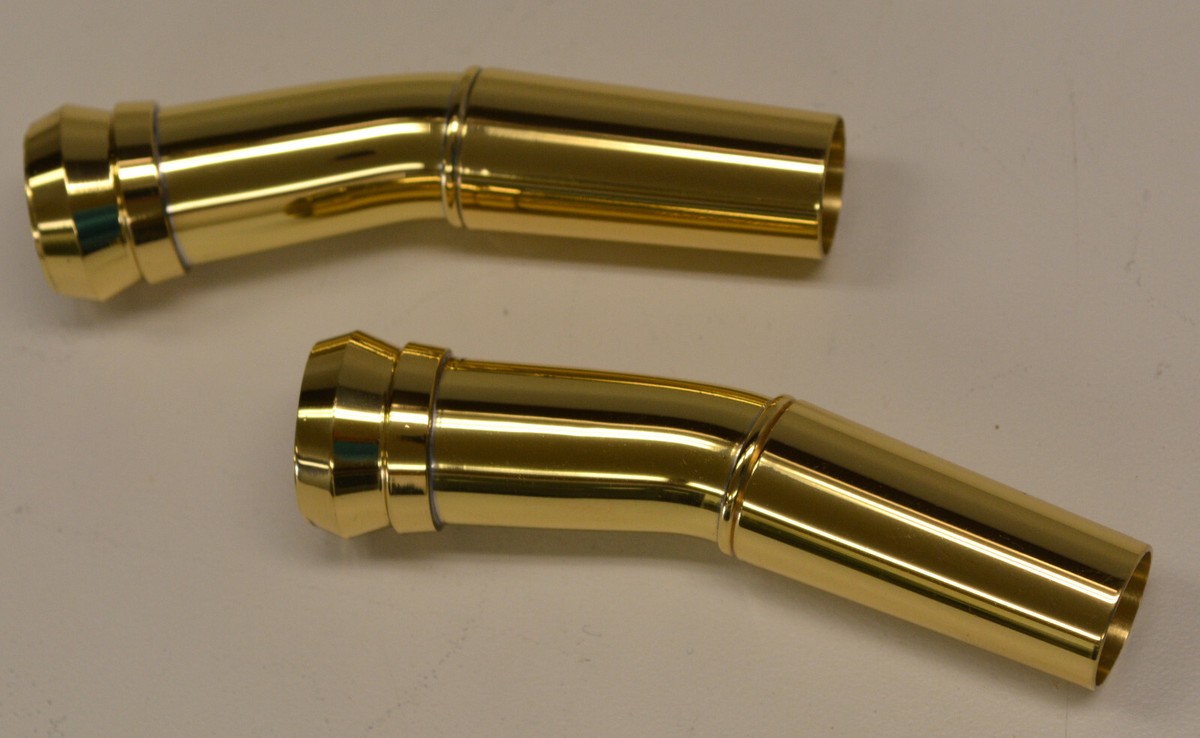
The Kings should take two bits which have a smaller opening and a larger opening, respectively. The mouthpiece goes into the one with the smaller opening, and that one goes into the one with the larger opening. I am not sure off the top of my head if these bits varied over the years between H.N. White era and UMI era, but I suspect differences are minor.