
I've never been much of a "mouthpiece guy" and haven't spent a ton of time thinking about them. Just got what a teacher recommended and stuck with it. These days, I've been thinking more about their characteristics and their effects. Right now I am concerned with euro vs american shank. Is this the sort of thing where you simply get the shank that matches your tuba? Or are there deeper considerations?
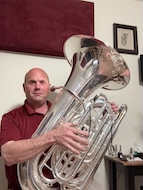
As seen in my profile pic, I have an Eastman 832, which I understand to be designed for euro shanks. It's the first tuba I have owned with a euro shank (I think - never thought about it). With all other MP characteristics being the same, is the euro shank going to serve me better?
Thanks
Stefan
Euro vs. American shank
Forum rules
This section is for posts that are directly related to performance, performers, or equipment. Social issues are allowed, as long as they are directly related to those categories. If you see a post that you cannot respond to with respect and courtesy, we ask that you do not respond at all.
This section is for posts that are directly related to performance, performers, or equipment. Social issues are allowed, as long as they are directly related to those categories. If you see a post that you cannot respond to with respect and courtesy, we ask that you do not respond at all.
-
bloke

- Mid South Music
- Posts: 26013
- Joined: Thu Aug 13, 2020 8:55 am
- Location: western Tennessee - near Memphis
- Has thanked: 5527 times
- Been thanked: 6447 times
Re: Euro vs. American shank
I locate the choke point down inside, and pick a mouthpiece whereby the small end of the shank stops about 1/8 or possibly 5/32 or 3/16 of an inch back from that choke point.
Others state that they prefer father setbacks (which reveals more of the reverse taper of the receiver incorporated into the pre-bore of the instrument).
There was a lively discussion very recently about a commonly school-bought model (a knock off of an American model) whereby the choke point is only about a half an inch, yet the receiver extends way out whereby the best OUTWARDLY APPEARING shank size is the large "euro" shank size, yet the small end of the shank sits way back from the choke point... and I mean WAY back (whereby I would probably saw at least a quarter inch off the end of the receiver, and use an old school English/bass trombone size shank mouthpiece on that model of instrument).
By "choke point", I'm referring to where the receiver ends at its smallest point and the mouth pipe begins at its smallest point... basically, the venturi at the very end of the receiver.
To each their own.
Others state that they prefer father setbacks (which reveals more of the reverse taper of the receiver incorporated into the pre-bore of the instrument).
There was a lively discussion very recently about a commonly school-bought model (a knock off of an American model) whereby the choke point is only about a half an inch, yet the receiver extends way out whereby the best OUTWARDLY APPEARING shank size is the large "euro" shank size, yet the small end of the shank sits way back from the choke point... and I mean WAY back (whereby I would probably saw at least a quarter inch off the end of the receiver, and use an old school English/bass trombone size shank mouthpiece on that model of instrument).
By "choke point", I'm referring to where the receiver ends at its smallest point and the mouth pipe begins at its smallest point... basically, the venturi at the very end of the receiver.
To each their own.