
So, no one ever shows up with a 6/4 Martin?
I was just now getting in a little practice on the tuba pictured above, and I had to stop and pull up the computer to make a suggestion. Small/medium/large/BAT may mean enough to be worth the trouble, or may not. I mean, is a tuba not "large"? Anything less than "large" seems like a bit of a compromise, and then BAT goes so far beyond reasonably large that it has to ascribe the "A" attribute to the instrument that it does not in reality have. Between these two there should perhaps be another category - "Just Right."
Discussion of tuba sizing
Forum rules
This section is for posts that are directly related to performance, performers, or equipment. Social issues are allowed, as long as they are directly related to those categories. If you see a post that you cannot respond to with respect and courtesy, we ask that you do not respond at all.
This section is for posts that are directly related to performance, performers, or equipment. Social issues are allowed, as long as they are directly related to those categories. If you see a post that you cannot respond to with respect and courtesy, we ask that you do not respond at all.
-
bloke

- Mid South Music
- Posts: 26018
- Joined: Thu Aug 13, 2020 8:55 am
- Location: western Tennessee - near Memphis
- Has thanked: 5527 times
- Been thanked: 6452 times
Re: Discussion of tuba sizing
ok...but just one last question:
Has anyone ever tried this (fwiw: I see no monkey in the trademark...) on any of their tubas?...
...OR: Is the closest that anyone has every come to "magic sizing" been when a different bottom bow and bell were made for a PT-6, and it magically became a PT-7...??

Has anyone ever tried this (fwiw: I see no monkey in the trademark...) on any of their tubas?...
...OR: Is the closest that anyone has every come to "magic sizing" been when a different bottom bow and bell were made for a PT-6, and it magically became a PT-7...??
-
Three Valves

- Posts: 5016
- Joined: Thu Aug 13, 2020 4:07 pm
- Location: The Land of Pleasant Living
- Has thanked: 1062 times
- Been thanked: 577 times
Re: Discussion of tuba sizing
So it is written, so let it be done....LeMark wrote: Sun Jan 17, 2021 10:55 am I hate these discussions, but yet, there is a solution to this problem. Measure internal volume, like they do engine blocks. (as per pjv in a previous comment)
Then you would have people bragging about their 28 gallon tuba, and looking down on someone who likes their 26 gallon tuba more

Thought Criminal
Mack Brass Artiste
TU422L with TU25
1964 Conn 36k with CB Arnold Jacobs
Accent (By B&S) 952R with Bach12
The Fourth Estate is the Fifth Column
Mack Brass Artiste
TU422L with TU25
1964 Conn 36k with CB Arnold Jacobs
Accent (By B&S) 952R with Bach12
The Fourth Estate is the Fifth Column
-
matt g

- Posts: 2604
- Joined: Thu Aug 13, 2020 10:37 am
- Location: Southeastern New England
- Has thanked: 269 times
- Been thanked: 561 times
Re: Discussion of tuba sizing
The PT-7P and VMI Mel Culbertson (rotary and piston) versions were definitely an example of where bell throat/bell ferrule doesn’t lend much clarity to the discussion. Having owned one of those, a monstrous Holton that predated the 345, and a 2165, those B&S/VMI horns don’t stack up even though the bell was pretty darn big. Plus, there’s probably a reason why PT-7Ps seem to be pretty rare, when the PT-6(P) offers about the same sound, more agility, and better intonation. But that’s another discussion.bloke wrote: Mon Jan 18, 2021 12:47 pm ...OR: Is the closest that anyone has every come to "magic sizing" been when a different bottom bow and bell were made for a PT-6, and it magically became a PT-7...??
I haven’t measured a 2xJ, but from what I can recall, the upper bow on those is a hair smaller than a 345.
Anyhow, if the double bass is where all of this referencing is coming from, then “grand orchestral” tubas would be 4/4 and something like the Miraphone 186 would be 3/4 and the small horns 1/2 or whatever.
Dillon/Walters CC (sold)
Meinl-Weston 2165 (sold)
Meinl-Weston 2165 (sold)
-
Dan Tuba
- Posts: 218
- Joined: Sat Aug 15, 2020 8:01 pm
- Location: Cameron, NC
- Has thanked: 89 times
- Been thanked: 79 times
Re: Discussion of tuba sizing
Nope, never seen a Martin 6/4 in the wild. But that tuba still wouldn't be larger, right? Cause if it is, I gotta do something about that. I'm kinda nervous now. I'm just talking about physical size, not bottom bows, too bows, etc, lol.donn wrote: Mon Jan 18, 2021 12:35 pm So, no one ever shows up with a 6/4 Martin?
I was just now getting in a little practice on the tuba pictured above, and I had to stop and pull up the computer to make a suggestion. Small/medium/large/BAT may mean enough to be worth the trouble, or may not. I mean, is a tuba not "large"? Anything less than "large" seems like a bit of a compromise, and then BAT goes so far beyond reasonably large that it has to ascribe the "A" attribute to the instrument that it does not in reality have. Between these two there should perhaps be another category - "Just Right."
Conn 25J
Holton Monster 3+1 EEb
Faxx 24AW
Holton Monster 3+1 EEb
Faxx 24AW
-
bloke
- Mid South Music
- Posts: 26018
- Joined: Thu Aug 13, 2020 8:55 am
- Location: western Tennessee - near Memphis
- Has thanked: 5527 times
- Been thanked: 6452 times
Re: Discussion of tuba sizing
I believe I'm coming around to lost's way of thinking...
Size designations (as I pointed out - with so many variables in tuba design...or maybe lost first pointed it out...??) are pretty silly, and two in the same size range are likely to not sound/play at all the same.
That having been said, I may have found a 1/64th-size tuba...for my 1/64th-size monkey:


Otherwise, when others get all worked up over fractionally-significant things, it's still quite entertaining to watch.
...now: back to serious stuff...
______________________________
edited: to get rid of the capital "L's mistakenly typed in "lost"
Size designations (as I pointed out - with so many variables in tuba design...or maybe lost first pointed it out...??) are pretty silly, and two in the same size range are likely to not sound/play at all the same.
That having been said, I may have found a 1/64th-size tuba...for my 1/64th-size monkey:
Otherwise, when others get all worked up over fractionally-significant things, it's still quite entertaining to watch.
...now: back to serious stuff...
______________________________
edited: to get rid of the capital "L's mistakenly typed in "lost"
Last edited by bloke on Mon Jan 18, 2021 6:00 pm, edited 2 times in total.
-
Three Valves
- Posts: 5016
- Joined: Thu Aug 13, 2020 4:07 pm
- Location: The Land of Pleasant Living
- Has thanked: 1062 times
- Been thanked: 577 times
Re: Discussion of tuba sizing
Enough monkeyshines!!
Some of us are trying to learn something. 
Some of us
are trying to learn something. Thought Criminal
Mack Brass Artiste
TU422L with TU25
1964 Conn 36k with CB Arnold Jacobs
Accent (By B&S) 952R with Bach12
The Fourth Estate is the Fifth Column
Mack Brass Artiste
TU422L with TU25
1964 Conn 36k with CB Arnold Jacobs
Accent (By B&S) 952R with Bach12
The Fourth Estate is the Fifth Column
-
bort2.0

- Posts: 6025
- Joined: Thu Aug 13, 2020 9:13 am
- Location: Minneapolis
- Has thanked: 471 times
- Been thanked: 1286 times
-
bloke
- Mid South Music
- Posts: 26018
- Joined: Thu Aug 13, 2020 8:55 am
- Location: western Tennessee - near Memphis
- Has thanked: 5527 times
- Been thanked: 6452 times
-
bort2.0
- Posts: 6025
- Joined: Thu Aug 13, 2020 9:13 am
- Location: Minneapolis
- Has thanked: 471 times
- Been thanked: 1286 times
Re: Discussion of tuba sizing
Confession -- in my mind, I say "four four," "five four", and "six four"
-
LeMark

- Site Admin
- Posts: 3200
- Joined: Wed Aug 12, 2020 8:03 am
- Location: Arlington TX
- Has thanked: 99 times
- Been thanked: 1042 times
Re: Discussion of tuba sizing
That's a whole different pollbort2.0 wrote: Mon Jan 18, 2021 6:28 pm Confession -- in my mind, I say "four four," "five four", and "six four"
Yep, I'm Mark
-
Three Valves
- Posts: 5016
- Joined: Thu Aug 13, 2020 4:07 pm
- Location: The Land of Pleasant Living
- Has thanked: 1062 times
- Been thanked: 577 times
Re: Discussion of tuba sizing
Isn’t 4/4 eight bits?? 
Thought Criminal
Mack Brass Artiste
TU422L with TU25
1964 Conn 36k with CB Arnold Jacobs
Accent (By B&S) 952R with Bach12
The Fourth Estate is the Fifth Column
Mack Brass Artiste
TU422L with TU25
1964 Conn 36k with CB Arnold Jacobs
Accent (By B&S) 952R with Bach12
The Fourth Estate is the Fifth Column
-
lost

- Posts: 230
- Joined: Thu Aug 13, 2020 8:38 am
- Location: Massachusetts
- Has thanked: 9 times
- Been thanked: 38 times
- Contact:
Re: Discussion of tuba sizing
This was my earlier point. If they considered their Kaiser 5/4, then an American piston horn they copied which is larger can only go to 6/4 based on comparison of volume.matt g wrote: Mon Jan 18, 2021 12:11 pm Didn’t Hirsbrunner make a Kaiser BBb at the same time they copied the York?
J.W. York & Sons Performing Artist
http://www.YorkLoyalist.com
http://www.YorkLoyalist.com
-
bloke
- Mid South Music
- Posts: 26018
- Joined: Thu Aug 13, 2020 8:55 am
- Location: western Tennessee - near Memphis
- Has thanked: 5527 times
- Been thanked: 6452 times
Re: Discussion of tuba sizing
When a tuba is built 7 - 9 inches taller than another tuba (as the CSO York-style key-of-C lap sousaphones are often not much taller than three feet tall...37" tall seems common), the equivalent place in the expansion of the bugle of the taller one (compared to the shorter one) is necessarily going to occur (rather than "up top") around the area where the taller tuba's bottom bow ends...so the taller tuba's upper bow is going to necessarily be smaller diameter than the squatty CSO-style lap sousaphone's upper bow...though the taller one (where both straight bugles and laid out side-by-side) might be easily seen to sport just about as much overall bugle interior volume as the stubbier one.
Additionally, I doubt that an inch or two of bell pancake is going to add much interior volume (cubic inches/cubic centimeters/what-have-you) to a tuba.

This Hirsbrunner kaiser B-tuba is 44 inches tall with a 19" bell and am 807" valveset bore , and

this Miraphone kaiser B-tuba is about 45-1/2 inches tall, with a 17-3/8" bell diameter and a .835" valveset bore
again: if you look towards the small ends of the bottom bows of these very tall tubas, that's roughly the same place (in the overall bugle taper) where the apex of the top bow occurs in the key-of-C lap-sousaphones.
These kaiser B-tubas (to me) resemble huge "blown out" Miraphone 186 or Meinl-Weston 20 tubas, whereas the CSO York-style key-of-C lap sousaphones (to me) more resemble huge "blown out" and "cut-to-C" King 2341 tubas.
SUMMARIZING: It's a mistake to compare the upper bow of a tall kaiser B-tuba to the upper bow of a CSO key-of-C York-style lap sousaphone, notice that the lap sousaphone's upper bow is fatter, and - from that - determine that the entire instrument is fatter, because to do so is to look at two DIFFERENT percentage locations of the overall length in the tapers of those two instruments.
...but why is it that this entire thread continues to remind me of the works of Lewis Carroll...??

bloke "Drink me."
Additionally, I doubt that an inch or two of bell pancake is going to add much interior volume (cubic inches/cubic centimeters/what-have-you) to a tuba.
This Hirsbrunner kaiser B-tuba is 44 inches tall with a 19" bell and am 807" valveset bore , and
this Miraphone kaiser B-tuba is about 45-1/2 inches tall, with a 17-3/8" bell diameter and a .835" valveset bore
again: if you look towards the small ends of the bottom bows of these very tall tubas, that's roughly the same place (in the overall bugle taper) where the apex of the top bow occurs in the key-of-C lap-sousaphones.
These kaiser B-tubas (to me) resemble huge "blown out" Miraphone 186 or Meinl-Weston 20 tubas, whereas the CSO York-style key-of-C lap sousaphones (to me) more resemble huge "blown out" and "cut-to-C" King 2341 tubas.
SUMMARIZING: It's a mistake to compare the upper bow of a tall kaiser B-tuba to the upper bow of a CSO key-of-C York-style lap sousaphone, notice that the lap sousaphone's upper bow is fatter, and - from that - determine that the entire instrument is fatter, because to do so is to look at two DIFFERENT percentage locations of the overall length in the tapers of those two instruments.
...but why is it that this entire thread continues to remind me of the works of Lewis Carroll...??
bloke "Drink me."
-
lost
- Posts: 230
- Joined: Thu Aug 13, 2020 8:38 am
- Location: Massachusetts
- Has thanked: 9 times
- Been thanked: 38 times
- Contact:
Re: Discussion of tuba sizing
I get it.
I would *still* say that the volume in a lap sousaphone 6/4 tuba would exceed X Kaiser. The volume in the bell expands wider and the whole instrument expands faster regardless of how it's wrapped.
Apparently Hirsbrunner also believed this?
I would *still* say that the volume in a lap sousaphone 6/4 tuba would exceed X Kaiser. The volume in the bell expands wider and the whole instrument expands faster regardless of how it's wrapped.
Apparently Hirsbrunner also believed this?
J.W. York & Sons Performing Artist
http://www.YorkLoyalist.com
http://www.YorkLoyalist.com
-
bloke
- Mid South Music
- Posts: 26018
- Joined: Thu Aug 13, 2020 8:55 am
- Location: western Tennessee - near Memphis
- Has thanked: 5527 times
- Been thanked: 6452 times
Re: Discussion of tuba sizing
I guess I don’t get your point - or how Hirsbrunner’s past beliefs change the fatness of various instruments which exist in the present.
I’m not arguing...I’m just missing the point...apparently some sort of if/then point.
-
the elephant

- Posts: 5118
- Joined: Thu Aug 13, 2020 8:39 am
- Location: 32°50'57.0"N 90°24'34.9"W
- Has thanked: 3272 times
- Been thanked: 2624 times
Re: Discussion of tuba sizing
I have been preaching this for YEARS.
 HO, HO, HO! Santa thinks you're funny!
-
Rick Denney

- Resident Genius
- Posts: 1164
- Joined: Thu Aug 13, 2020 8:24 am
- Has thanked: 83 times
- Been thanked: 452 times
Discussion of tuba sizing
Okay, guys.
The quarter system was a way for any one company to distinguish instruments in their own product line. All Rudi Meinl rotary tubas are similarly configured, and their dimensionless ratios are sort-of similar. So, the 6/4 Rudi has a bigger bell, a bigger bore, a bigger throat, more volume, and a taller stack than a 5/4 Rudi. It isn’t just the 22” bell versus the 20” bell, but everything is bigger. Within the Rudi line, the quarter system applies to all dimensions, not just a few.
But RM’s idea of the standard full-size tuba is different than Miraphone’s, which is different than Alexander, which is different than Meinl-Weston.
I own a Hirsbrunner HBS-193 (pictured by Combatant B above), and also a Holton 345. The Holton is about five inches shorter, but it has a bigger throat and more volume. The sound is bottomless. The sound of the 193 is powerful. It’s like comparing a Bentley—a very large car with sporting intentions, to a Humvee, a tank with tires instead of tracks. Neither will get you quickly around a race track. But both support such different use cases that sharing a size designation beyond “big” is a fool’s errand. The Hirsbrunner is a Kaiser, which implies a range of characteristics common do all large and tall rotary tubas. The Rudi 5/4 is also a Kaiser, in my considered opinion. The Rudi 6/4 should be called a Döppelkaiser.
The Holton is a grand orchestral tuba, in the sense that the original 36J was called the Orchestra Grand Bass. It definitely has more volume, but the sound is different rather than greater.
The use of impedance is an interesting idea. Impedance is frequency-dependent resistance. Resonance implies low impedance, but there’s more to it than that. In the world of loudspeakers, the propagation and resonance of the speaker can be measured as a function of amplitude, decay, and direction. It avoids room effects by measuring single waveforms before reflections make it back to the test microphone. Equally interesting is measuring speakers in the room to see how the room affects resonance and frequency response. Propagation pattern is important—reflected paths arrive at the ear later than direct paths, and in a reverberant room, you’ll get a lot of phase cancellation and comb filtering in the upper harmonics relative to the lower ones. Reverberant rooms will favor clean articulations, fast attacks, higher harmonics, and direction propagation, while deader rooms will favor wide dispersion, lower harmonics, and smoother attacks.
Here’s a spectral decay plot showing where a loudspeaker resonates (bad) or nulls (also bad) across the frequency spectrum. These speakers are decent cheapies.

It’s not specifically useful for measuring tubas, which are intended to be resonant. But it’s more interesting than the simple Fourier transform frequency display like the one I used to measure tuba sound back in the deeps of time.
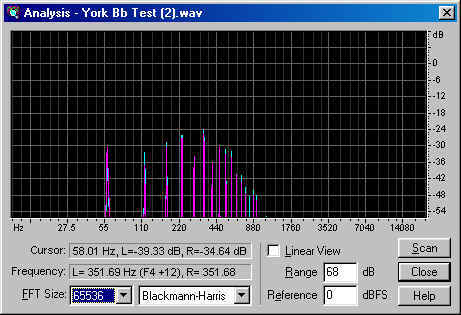
Here is a way to picture frequency response in a room. This room is fairly dead, but the waviness is caused by reflections out of phase with the main signal at some frequencies—the comb effect. The farther the test microphone is from the sound producer, the more it measures room effects. I’m going to play with this software to see if I can use it for measuring tuba sound. I think propagation has as much effect as harmonic content, but in a live hall, those two attributes are linked, sometimes to good effect and sometimes not. That more than anything drives preferences of those who make their decisions more thoughtfully that buying the currently hip thing.

By the way, here’s a Rudi 5/4 C tuba next to a Holton BB-345.

Differences are easy enough to see.
Rick “not at home, so having to file this away for a future project” Denney
The quarter system was a way for any one company to distinguish instruments in their own product line. All Rudi Meinl rotary tubas are similarly configured, and their dimensionless ratios are sort-of similar. So, the 6/4 Rudi has a bigger bell, a bigger bore, a bigger throat, more volume, and a taller stack than a 5/4 Rudi. It isn’t just the 22” bell versus the 20” bell, but everything is bigger. Within the Rudi line, the quarter system applies to all dimensions, not just a few.
But RM’s idea of the standard full-size tuba is different than Miraphone’s, which is different than Alexander, which is different than Meinl-Weston.
I own a Hirsbrunner HBS-193 (pictured by Combatant B above), and also a Holton 345. The Holton is about five inches shorter, but it has a bigger throat and more volume. The sound is bottomless. The sound of the 193 is powerful. It’s like comparing a Bentley—a very large car with sporting intentions, to a Humvee, a tank with tires instead of tracks. Neither will get you quickly around a race track. But both support such different use cases that sharing a size designation beyond “big” is a fool’s errand. The Hirsbrunner is a Kaiser, which implies a range of characteristics common do all large and tall rotary tubas. The Rudi 5/4 is also a Kaiser, in my considered opinion. The Rudi 6/4 should be called a Döppelkaiser.
The Holton is a grand orchestral tuba, in the sense that the original 36J was called the Orchestra Grand Bass. It definitely has more volume, but the sound is different rather than greater.
The use of impedance is an interesting idea. Impedance is frequency-dependent resistance. Resonance implies low impedance, but there’s more to it than that. In the world of loudspeakers, the propagation and resonance of the speaker can be measured as a function of amplitude, decay, and direction. It avoids room effects by measuring single waveforms before reflections make it back to the test microphone. Equally interesting is measuring speakers in the room to see how the room affects resonance and frequency response. Propagation pattern is important—reflected paths arrive at the ear later than direct paths, and in a reverberant room, you’ll get a lot of phase cancellation and comb filtering in the upper harmonics relative to the lower ones. Reverberant rooms will favor clean articulations, fast attacks, higher harmonics, and direction propagation, while deader rooms will favor wide dispersion, lower harmonics, and smoother attacks.
Here’s a spectral decay plot showing where a loudspeaker resonates (bad) or nulls (also bad) across the frequency spectrum. These speakers are decent cheapies.
It’s not specifically useful for measuring tubas, which are intended to be resonant. But it’s more interesting than the simple Fourier transform frequency display like the one I used to measure tuba sound back in the deeps of time.
Here is a way to picture frequency response in a room. This room is fairly dead, but the waviness is caused by reflections out of phase with the main signal at some frequencies—the comb effect. The farther the test microphone is from the sound producer, the more it measures room effects. I’m going to play with this software to see if I can use it for measuring tuba sound. I think propagation has as much effect as harmonic content, but in a live hall, those two attributes are linked, sometimes to good effect and sometimes not. That more than anything drives preferences of those who make their decisions more thoughtfully that buying the currently hip thing.
By the way, here’s a Rudi 5/4 C tuba next to a Holton BB-345.
Differences are easy enough to see.
Rick “not at home, so having to file this away for a future project” Denney
Last edited by Rick Denney on Mon Jan 18, 2021 11:19 pm, edited 1 time in total.
-
donn
- Posts: 1562
- Joined: Mon Oct 26, 2020 2:31 pm
- Location: Portugal
- Has thanked: 12 times
- Been thanked: 213 times
Re: Discussion of tuba sizing
There might be a pitfall in the apparent assumption that the largest American tubas are all built to the same pattern. Let's say that Holton 345 is pretty close to a big York, but to my eye the Conn 2XJ bell is not as wide, up to the point where it really starts flaring out. Maybe my eyes deceive me, maybe not, but there's no real reason that bells would have to be all the same on one side of the Atlantic.
(I see this post starts a new page. See previous page for more illuminating recent commentary.)
I think there may be some apprehension over the weight, but ... does it really capture the differences? It's possible for something like a Conn 52J to hold a lot of water in a generously sized bell, but the bows aren't so big (just looking at pictures)? If the bows aren't so big, it will make a lot more difference to the playing, than it does to the water reservoir capacity, I suspect - the bell is important to sound, but not as important as it is to internal volume?
(I see this post starts a new page. See previous page for more illuminating recent commentary.)