
Phoenix Symphony
Forum rules
This section is for posts that are directly related to performance, performers, or equipment. Social issues are allowed, as long as they are directly related to those categories. If you see a post that you cannot respond to with respect and courtesy, we ask that you do not respond at all.
This section is for posts that are directly related to performance, performers, or equipment. Social issues are allowed, as long as they are directly related to those categories. If you see a post that you cannot respond to with respect and courtesy, we ask that you do not respond at all.
Re: Phoenix Symphony
A screen only does so much. A prearranged cough or throat clear could tell someone on the panel exactly who’s playing. I’ve heard of that happening at a pretty reputable orchestra, though obviously I can’t verify it.
-
bloke

- Mid South Music
- Posts: 26012
- Joined: Thu Aug 13, 2020 8:55 am
- Location: western Tennessee - near Memphis
- Has thanked: 5527 times
- Been thanked: 6446 times
Re: Phoenix Symphony
as we've been steered off-topic, once again...
Of course, music directors should be able to hire whomever they see fit to hire, and for whatever reason.
Very few businesses hold "blind interviews".
Hiring someone because they play extremely well (or really know their stuff in engineering, or construction, or whatever) yet - otherwise - they're total nutcases...obviously causes chaos in a workplace.
If they make more than an occasional bad hiring decision, obviously the music directors themselves should be fired. (They often have over a 50% say in the voting anyway.)
I'm thinking of the countless millions of dollars (travel expenses, etc.) paid over the years by extremely naive applicants who believe they have a shot at (even) a sorta-OK-paying (or even poor-paying) per-service job.
OK...I just did some quick research. Perhaps 20% of businesses (a small percentage) use a "blind interview" process, but it almost only applies to the very earliest stages of recruitment.
a husband-and-wife working in the same orchestra...??
This might be a way whereby an orchestra can obtain two remarkably fine players - even though the pay is mediocre (or maybe even less than mediocre).
screens:
We've all heard multiple stories.
It's REALLY easy for an audition committee member to take a restroom break, stroll out to the parking area (designated for applicants) and take a peek at their license plates (particularly larger instruments, as such applicants - who have a lick of sense - won't be allowing their instruments to be tossed in thee bellies of airliners, and nor are they likely to be willing to buy seats for their instruments). We've also heard stories about committee members looking up and back (at the slanted glass up high in the back of the hall up in the control booth) to look up-and-back at the reflection, and see who's up there on the stage auditioning. It's even easier for committee members to stroll about (prior to semi-final and final rounds), and - simply - notice who is in the waiting area. We've also all heard of "warm-up notes codes" played by auditioning buddies of committee members.
Last edited by bloke on Wed Oct 21, 2026 8:45 pm, edited 1 time in total.

Re: Phoenix Symphony
The orchestra had a principal trumpet audition. Hired someone.AvrTuba wrote: Wed Oct 21, 2026 1:17 pmTimtamtuba wrote: Wed Oct 21, 2026 1:10 pm
it feels like these orchestras decide who they want before the fact
Aren't the principal trumpet and tuba player in The Phoenix Symphony married?
Surely that's just a coincidence.
The orchestra later had a principal tuba audition. Hired someone.
The principal trumpet they hired left the orchestra. I do not know why.
The orchestra had another principal trumpet audition. Hired the tuba player's spouse.
I'm sure the current principal trumpet does play at a high level, as I'm sure did the previous principal trumpet. There are so many players that perform at a high level.
Who doesn't like conspiracy theories?
- These users thanked the author jtuba for the post (total 2):
- Colby Fahrenbacher (Thu Oct 22, 2026 7:05 am) • sweaty (Thu Oct 22, 2026 8:26 am)
-
bloke
- Mid South Music
- Posts: 26012
- Joined: Thu Aug 13, 2020 8:55 am
- Location: western Tennessee - near Memphis
- Has thanked: 5527 times
- Been thanked: 6446 times
Re: Phoenix Symphony
The LAPO has a husband-and-wife in its horn section.
connections? of course.
competence? I worked (for quite a few years) with the SECOND spouse hired into that section...' remarkable competence.
connections? of course.
competence? I worked (for quite a few years) with the SECOND spouse hired into that section...' remarkable competence.
-
Mary Ann

- Posts: 4560
- Joined: Thu Aug 13, 2020 9:24 am
- Has thanked: 921 times
- Been thanked: 1039 times
Re: Phoenix Symphony
I heard about this last night at brass band from our solo cornet -- who does a lot of freeway phil stuff, and was planning to get back on their sub list. She said 1M in debt and nothing coming in.
On conspiracy theories -- TSO's 2nd trumpet was hired, her not-yet-husband moved here from Virginia to be with her, and he was subsequently hired as tuba when the long-term tuba player retired. His competence is very high.
Sometimes -- in places that are not huge cities, it is desired that the people who are hired actually hang around and not use the orchestra as a stepping stone. That can result at times in someone's being hired who is local, known and liked, and is fully competent but who might not be the Be All And End All Of All Players, because the Be All person might stay a year and then move up or on, while the local person, especially if married to another known, liked, and fully competent player, will stay, and the orchestra will be more stable because of it. You can call that politics if you like, but it is a fact of life especially in regional orchestras.
-
Timtamtuba
- Posts: 121
- Joined: Sat May 30, 2026 4:58 pm
- Has thanked: 6 times
- Been thanked: 25 times
Re: Phoenix Symphony
You don't even have to go this far in my opinion, if you're professor is in the orchestra, whether or not they are involved in the hiring process you can very easily just have a conversation and get "The conductor likes this played this way, likes that played that way" ect. Which would give the applicant a pretty significant and legitimate advantage. Also a professor involved in the hiring process would know how they're student sounds, maybe they'd be asked to recuse themselves but I guess thats another insider detail. Either way in the tuba world we are talking about what maybe a few dozen positions in the entire country? I just think its an interesting observation that most likely has a real reason behind it.bloke wrote: Wed Oct 21, 2026 8:38 pm as we've been steered off-topic, once again...
Of course, music directors should be able to hire whomever they see fit to hire, and for whatever reason.
Very few businesses hold "blind interviews".
Hiring someone because they play extremely well (or really know their stuff in engineering, or construction, or whatever) yet - otherwise - they're total nutcases...obviously causes chaos in a workplace.
If they make more than an occasional bad hiring decision, obviously the music directors themselves should be fired. (They often have over a 50% say in the voting anyway.)
I'm thinking of the countless millions of dollars (travel expenses, etc.) paid over the years by extremely naive applicants who believe they have a shot at (even) a sorta-OK-paying (or even poor-paying) per-service job.
OK...I just did some quick research. Perhaps 20% of businesses (a small percentage) use a "blind interview" process, but it almost only applies to the very earliest stages of recruitment.
a husband-and-wife working in the same orchestra...??
This might be a way whereby an orchestra can obtain two remarkably fine players - even though the pay is mediocre (or maybe even less than mediocre).
screens:
We've all heard multiple stories.
It's REALLY easy for an audition committee member to take a restroom break, stroll out to the parking area (designated for applicants) and take a peek at their license plates (particularly larger instruments, as such applicants - who have a lick of sense - won't be allowing their instruments to be tossed in thee bellies of airliners, and nor are they likely to be willing to buy seats for their instruments). We've also heard stories about committee members looking up and back (at the slanted glass up high in the back of the hall up in the control booth) to look up-and-back at the reflection, and see who's up there on the stage auditioning. It's even easier for committee members to stroll about (prior to semi-final and final rounds), and - simply - notice who is in the waiting area. We've also all heard of "warm-up notes codes" played by auditioning buddies of committee members.
-
bisontuba

- Posts: 1295
- Joined: Thu Aug 13, 2020 8:08 am
- Location: Bottom of Lake Erie
- Has thanked: 271 times
- Been thanked: 1167 times
Re: Phoenix Symphony
bloke wrote: Wed Oct 21, 2026 8:38 pm as we've been steered off-topic, once again...
Of course, music directors should be able to hire whomever they see fit to hire, and for whatever reason.
Very few businesses hold "blind interviews".
Hiring someone because they play extremely well (or really know their stuff in engineering, or construction, or whatever) yet - otherwise - they're total nutcases...obviously causes chaos in a workplace.
If they make more than an occasional bad hiring decision, obviously the music directors themselves should be fired. (They often have over a 50% say in the voting anyway.)
I'm thinking of the countless millions of dollars (travel expenses, etc.) paid over the years by extremely naive applicants who believe they have a shot at (even) a sorta-OK-paying (or even poor-paying) per-service job.
OK...I just did some quick research. Perhaps 20% of businesses (a small percentage) use a "blind interview" process, but it almost only applies to the very earliest stages of recruitment.
a husband-and-wife working in the same orchestra...??
This might be a way whereby an orchestra can obtain two remarkably fine players - even though the pay is mediocre (or maybe even less than mediocre).
screens:
We've all heard multiple stories.
It's REALLY easy for an audition committee member to take a restroom break, stroll out to the parking area (designated for applicants) and take a peek at their license plates (particularly larger instruments, as such applicants - who have a lick of sense - won't be allowing their instruments to be tossed in thee bellies of airliners, and nor are they likely to be willing to buy seats for their instruments). We've also heard stories about committee members looking up and back (at the slanted glass up high in the back of the hall up in the control booth) to look up-and-back at the reflection, and see who's up there on the stage auditioning. It's even easier for committee members to stroll about (prior to semi-final and final rounds), and - simply - notice who is in the waiting area. We've also all heard of "warm-up notes codes" played by auditioning buddies of committee members.
-
bisontuba
- Posts: 1295
- Joined: Thu Aug 13, 2020 8:08 am
- Location: Bottom of Lake Erie
- Has thanked: 271 times
- Been thanked: 1167 times
Re: Phoenix Symphony
Screens are needed...
so that the best person wins.
And depending on the orchestra, a music director can have final say, have a weighted vote, or in two large orchestra sections, no vote at all...
so that the best person wins.
And depending on the orchestra, a music director can have final say, have a weighted vote, or in two large orchestra sections, no vote at all...
- These users thanked the author bisontuba for the post:
- Colby Fahrenbacher (Fri Oct 23, 2026 6:01 am)
-
bloke
- Mid South Music
- Posts: 26012
- Joined: Thu Aug 13, 2020 8:55 am
- Location: western Tennessee - near Memphis
- Has thanked: 5527 times
- Been thanked: 6446 times
Re: Phoenix Symphony
bisontuba wrote: Thu Oct 22, 2026 11:47 am Screens are needed...
so that the best person wins.
And depending on the orchestra, a music director can have final say, have a weighted vote, or in two large orchestra sections, no vote at all...

Re: Phoenix Symphony
bisontuba wrote: Thu Oct 22, 2026 11:47 am Screens are needed...
so that the best person wins.
And depending on the orchestra, a music director can have final say, have a weighted vote, or in two large orchestra sections, no vote at all...

-
bisontuba
- Posts: 1295
- Joined: Thu Aug 13, 2020 8:08 am
- Location: Bottom of Lake Erie
- Has thanked: 271 times
- Been thanked: 1167 times
-
bloke
- Mid South Music
- Posts: 26012
- Joined: Thu Aug 13, 2020 8:55 am
- Location: western Tennessee - near Memphis
- Has thanked: 5527 times
- Been thanked: 6446 times
Re: Phoenix Symphony
Why not just put a sheet (with holes for the mouth and hands) over each applicant?
A screen blocks out the true resonance of the Chinese tubas.
A screen blocks out the true resonance of the Chinese tubas.
-
Colby Fahrenbacher
- Posts: 292
- Joined: Thu Aug 13, 2020 5:51 pm
- Has thanked: 29 times
- Been thanked: 89 times
Re: Phoenix Symphony
Blind audition practices are necessary if an audition is going to have any chance of being remotely fair. It's not perfect, but it is far more merit-based than the "conductor invites people up to his hotel room" days. There are plenty of legitimate reasons to consider dropping the screen (such as trying to avoid hiring a douche bag who plays their ass off), but it always runs the risk of allowing inappropriate biases to influence auditions.
Former Tubist, USAF Bands
-
bloke
- Mid South Music
- Posts: 26012
- Joined: Thu Aug 13, 2020 8:55 am
- Location: western Tennessee - near Memphis
- Has thanked: 5527 times
- Been thanked: 6446 times
Re: Phoenix Symphony
immediately previous response:
"thank/agree-with, conditionally"
- A very large percentage of working orchestral musicians I know really do not enjoy sitting all day listening to cattle calls behind a bed sheet (often without being paid), particularly not when it's someone who's not in their own section.
- The problem with preliminary rounds is that there are so many people there who are either nowhere close to being ready to fill even any orchestral position competently, and likely never will be, yet they are completely un-self-aware of this. This wastes their time, their money, and wastes the unpaid time of orchestra members (over and over - x every orchestra in the country).
- For those who know damn well that they're not ready, and tell others that they are auditioning "for the experience", that - in my view, at least - is particularly rude and inconsiderate of the time of those on the committee - who are listening to applicants without being paid (as TIME is all that anyone has in their life, really).
- With private corporations, I've never been particularly concerned with "fairness". The corporation is spending THEIR money, and should be able to spend it as they see fit, and not as others see fit. ANY which isn't seeking the best possible applicant they can find is behaving foolishly, and deserves the consequences. My tiny corporation includes two officers who are the same two people who are the employees. We don't need some outside organization (nor inside set of hard and fast rules) telling us how to hire people, were we to again decide to hire help. Our criteria are our own. EVEN IF an orchestra decides that they are only going to consider hiring the most competent minority musician that applies (or some other criteria which would confidentially disqualify a whole bunch of applicants who would otherwise be highly qualified), that's THEIR business (though such a factor - undisclosed - would be particularly rude to any applicants who weren't considered to be minorities (or whatever specific side-characteristic or qualification sought), as - again - the orchestra would be wasting TIME out of quite a few people's lives.
- Back during the classical/orchestral music revival of the '70s and into the '80s (when "garbage" concerts weren't necessary to be able to sell tickets and fill seats), a whole bunch of the orchestral musicians (if not most of them) were people who (when they originally auditioned) had simply played for the music director via recommendation or reputation. Those were some mighty good orchestras and they made some mighty good (and pre digital, without hundreds and hundreds of splices) recordings.
- I was asked to listen to principal horn player auditions less than a handful of years ago. Fortunately I had a gig, so I had a legitimate excuse. They ended up with a wonderful player, but management were such asses that the horn player they hired walked away from the job after a few months (as did many of the rest of us). Management also fired a very popular (with the musicians as well as the public) a very talented maestro, and replaced them with a hack, but whatever on that as well.
I wonder about putting a sheet around conductors (with only their arms sticking out), when they are auditioning for their jobs.
One last comment about the bed sheet:
We all know who Louis Armstrong was and who Rich Matteson was.
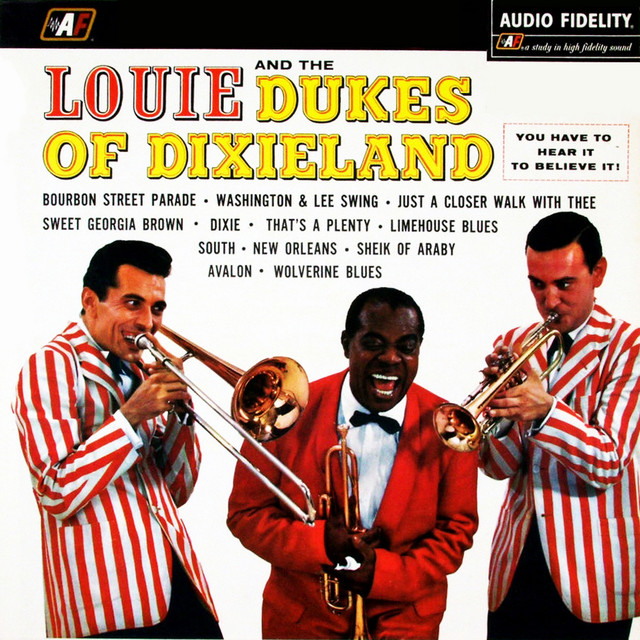
Rich was a member of the original (wildly popular) Assunto family Dukes of Dixieland for a couple of years or so in the very early 1960s (during the first dixieland music revival). One of their LPs (of their impressive Audio Fidelity series) was a collaboration with Louis Armstrong. In his writings (or perhaps it was from an interview?), Matteson reported that - for every solo and every vocal chorus, Armstrong looked into the control booth at the control booth operators as he played or sung.
Matteson asked him about it, and Armstrong told him that he plays and sings from the heart, and he had to play TO and FOR someone, rather than just play to no one.
Perhaps we view our orchestral excerpts played at our auditions as so very sterile, whereby that isn't really necessary...(??)
Sure, we may have played them thousands of times with hopes of being hired to play with an orchestra, but how many times do you suppose that Mr Armstrong played and sung the songs that he performed?
--------------------------
FOOTNOTE:
If anyone researches this, this is a recently AI-created picture (I recognize most of those of those specific musicians as having been pulled from other pictures), and features band members who had been in the band but had left the band prior to the specific recordings to which I refer:
(The ORIGINAL album cover simply featured Mr Armstrong, the trumpet playing bandleader, and his brother who was the trombonist.)

"thank/agree-with, conditionally"
- A very large percentage of working orchestral musicians I know really do not enjoy sitting all day listening to cattle calls behind a bed sheet (often without being paid), particularly not when it's someone who's not in their own section.
- The problem with preliminary rounds is that there are so many people there who are either nowhere close to being ready to fill even any orchestral position competently, and likely never will be, yet they are completely un-self-aware of this. This wastes their time, their money, and wastes the unpaid time of orchestra members (over and over - x every orchestra in the country).
- For those who know damn well that they're not ready, and tell others that they are auditioning "for the experience", that - in my view, at least - is particularly rude and inconsiderate of the time of those on the committee - who are listening to applicants without being paid (as TIME is all that anyone has in their life, really).
- With private corporations, I've never been particularly concerned with "fairness". The corporation is spending THEIR money, and should be able to spend it as they see fit, and not as others see fit. ANY which isn't seeking the best possible applicant they can find is behaving foolishly, and deserves the consequences. My tiny corporation includes two officers who are the same two people who are the employees. We don't need some outside organization (nor inside set of hard and fast rules) telling us how to hire people, were we to again decide to hire help. Our criteria are our own. EVEN IF an orchestra decides that they are only going to consider hiring the most competent minority musician that applies (or some other criteria which would confidentially disqualify a whole bunch of applicants who would otherwise be highly qualified), that's THEIR business (though such a factor - undisclosed - would be particularly rude to any applicants who weren't considered to be minorities (or whatever specific side-characteristic or qualification sought), as - again - the orchestra would be wasting TIME out of quite a few people's lives.
- Back during the classical/orchestral music revival of the '70s and into the '80s (when "garbage" concerts weren't necessary to be able to sell tickets and fill seats), a whole bunch of the orchestral musicians (if not most of them) were people who (when they originally auditioned) had simply played for the music director via recommendation or reputation. Those were some mighty good orchestras and they made some mighty good (and pre digital, without hundreds and hundreds of splices) recordings.

- I was asked to listen to principal horn player auditions less than a handful of years ago. Fortunately I had a gig, so I had a legitimate excuse. They ended up with a wonderful player, but management were such asses that the horn player they hired walked away from the job after a few months (as did many of the rest of us). Management also fired a very popular (with the musicians as well as the public) a very talented maestro, and replaced them with a hack, but whatever on that as well.

I wonder about putting a sheet around conductors (with only their arms sticking out), when they are auditioning for their jobs.
One last comment about the bed sheet:
We all know who Louis Armstrong was and who Rich Matteson was.
Rich was a member of the original (wildly popular) Assunto family Dukes of Dixieland for a couple of years or so in the very early 1960s (during the first dixieland music revival). One of their LPs (of their impressive Audio Fidelity series) was a collaboration with Louis Armstrong. In his writings (or perhaps it was from an interview?), Matteson reported that - for every solo and every vocal chorus, Armstrong looked into the control booth at the control booth operators as he played or sung.
Matteson asked him about it, and Armstrong told him that he plays and sings from the heart, and he had to play TO and FOR someone, rather than just play to no one.
Perhaps we view our orchestral excerpts played at our auditions as so very sterile, whereby that isn't really necessary...(??)
Sure, we may have played them thousands of times with hopes of being hired to play with an orchestra, but how many times do you suppose that Mr Armstrong played and sung the songs that he performed?
--------------------------
FOOTNOTE:
If anyone researches this, this is a recently AI-created picture (I recognize most of those of those specific musicians as having been pulled from other pictures), and features band members who had been in the band but had left the band prior to the specific recordings to which I refer:
(The ORIGINAL album cover simply featured Mr Armstrong, the trumpet playing bandleader, and his brother who was the trombonist.)
-
bloke
- Mid South Music
- Posts: 26012
- Joined: Thu Aug 13, 2020 8:55 am
- Location: western Tennessee - near Memphis
- Has thanked: 5527 times
- Been thanked: 6446 times
Re: Phoenix Symphony
I tend to wonder what many of these executive directors are ACTUALLY qualified to do. (sack groceries... or would they put the eggs underneath the frozen meat ??)AvrTuba wrote: Fri Oct 23, 2026 3:54 pm https://www.phoenixsymphony.org/updates/
Oh look, they also need $10,000,000...
-
Colby Fahrenbacher
- Posts: 292
- Joined: Thu Aug 13, 2020 5:51 pm
- Has thanked: 29 times
- Been thanked: 89 times
Re: Phoenix Symphony
It’s really worth noting that literally nothing mentioned in that unnecessarily long post has anything to do with blind auditions.
Blind auditions can be conducted with or without being cattle calls.
Blind auditions can be run whether the committee is paid or not.
Private corporations are beheld to laws too, so yes, they do get told what they can and cannot do, which includes prevention of discriminatory hiring practices.
And just like there used to be many fine orchestras that were employed using “conductor hotel room auditions”, there are many fine orchestras now who are employed by blind audition practices.
No one can say whether the orchestra members of old would have won their jobs or not through a blind audition. But we do know that a blind audition would have been significantly less likely to have results influenced by racism, sexism, and other non-musical forms of discrimination.
Former Tubist, USAF Bands