Tubas, euphoniums, mouthpieces, and anything music-related.
Forum rules
This section is for posts that are directly related to performance, performers, or equipment. Social issues are allowed, as long as they are directly related to those categories. If you see a post that you cannot respond to with respect and courtesy, we ask that you do not respond at all.
Alex C wrote: Mon Sep 27, 2021 11:23 am
I was once in a very intense discussion about the nomenclature of 6/4 vs 5/4 vs 4/4 when Ed Jones, suggested that if the manufacturer says a tuba is a 5/4... it's a 5/4. When they say it's a 6/4, it's a 6/4.
If they don't say, I don't suppose it matters.
How happy would you be if Ford sold you a mustang 5.0L but with a 2.3L ecoboost under the hood, even if Ford says it is a 5.0L .
You have missed the point, Peter.
The Mustang has a measurable, quantitative engine size. Tubas do not. There is no quantitative measurement which says one tuba is 6/4 and another is 5/4. If there is, tell me because that is something we would all like to know.
Violin/viola/cello/bass sizes (ie. the instruments of the orchestra which ACTUALLY carry the weight, which are ACTUALLY musically expressive, and which deliver 95% of the ACTUAL music to the patrons) are very specific, and the instruments remain proportional.
Tuba sizes are bullsh!t and randomly-assigned - often, for marketing purposes. Attempts (even if genuine) at F tuba sizing are particularly random, with some that seem to play "stronger" (etc.) actually being smaller in overall interior spacial volume.
four quarter to one sixteenth.png (87.15 KiB) Viewed 7662 times
Violins don’t have bore sizes.
Obviously they vary, but it’s difficult to tell one from the other from even five feet away.
A “4/4” tuba can feature of bore size all the way from 11/16” all the way up to 13/16”.
This represents a 1/8ths diameter discrepancy and far more than that as a volume discrepancy.
Interesting. Looks to me like the Cerveny Piggy's bore is roughly 25% larger than the Conn 2J's bore. (A little more, but then it's farther down the leadpipe, too, so who knows.) How much louder would it be, then?
I never touched a violin, but fooled around a little with a viola, and I believe it's true of all the instruments of that family from viola down - they're all undersized, compared to any acoustic ideal, it's just a question of how much, so you play the biggest one you can get your arms around. Were it possible to go as big as you want - e.g., the "vertical viola" configured like violoncello - the body size would be determined by the resonance of the middle two strings. Larger would be just foolish. Tuba sizing not so linked to any obvious acoustic parameter.
Donn’s comments point out yet another problem with all of the silly and accomplish-nothing attempts at trying to label tuba models as to size:
“individual opinions of which models are which sizes”
Personally, I would ignore the bell pancake and label a Conn model 2J as a 3/4 (or 7/8, as that designation became popular – possibly beginning with me…?? – around a decade or so ago), and I would ignore the compact wrap and lack of a bell pancake (Saint Petersburg or Cerveny piggy) and label those no-resistance-whatsoever instruments as probably 5/4 or possibly “9/8”.
Again, [1] the way that tubas are wrapped and [2] their bell pancake (or lack thereof) are visually deceptive, and to size a tuba is to necessarily ignore its capillary bore completely.
The only really meaningful things about labeling a tuba are to identify its make and model, and to have played that make and model.
OK, so, recognizing that the tuba is conical, and thus unlike the trombone which can be usefully classified under a single tube size parameter - here we're breaking out a couple parameters. Internal volume, which is of course dominated by the bell - so maybe it ought to be 1.a. bell volume, 1.b. large branch volume. Then there's 2. valve tubing, 3. leadpipe tubing, which has come up here occasionally as a significant parameter in tubas where different leadpipes are available, and 4. bell flare, which plays some role in sound but few would accept as a significant size parameter.
Our enthusiasm for tubology will surely lead us to collect these dimensions for various tubas, and then we'll know all! Choosing a tuba will be ... just like it has always been. Because there's no way those parameters operate independently to control some aspect of a tuba's performance. That's my point about the valve tubing diameter. A King's .687 valve tubing doesn't make it a lesser tuba than an .827 Piggy. Sure, it makes a difference, but if you transplant valves from one to the other, the results are not guaranteed to carry along the desirable properties of the donor - as they would, if these parameters reliably predicted some aspect of tuba performance.
The only really meaningful things about labeling a tuba are to identify its make and model, and to have played that make and model.
Kind of like (and about as affective as) walking in a restaurant and asking for "a plate of food" or a car dealer and asking for "anything with tires will do".
It does seem that in general, the way tubas have been measured has been leaning more towards "girth" or "fatness" instead of overall height or Bore size. For instance, if you call a St. Petersburg a 5/4 or even 6/4...then you transplant that big .830'' valve section onto a Yamaha YBB-103 does that now make that little 3/4 Yamaha a 5/4 tuba? If so, fine but it has to be universally agreed upon that we are now determining "tuba fractional sizing" by JUST the bore diameter. If it was up to me, I'd label sizing by overall height and girth in combination not relative to bore sizing at all (Which wouldnt do the Miraphone 187 and 188's any justice because I firmly think the equation would land those two at the beginning of the 5/4 range but they are still considered 4/4.
If I don't know the make/model and/or have never played a make/model, I don't know anything - and wouldn't hazard any guesses - about it - regardless of whether someone has been courteous enough to tell me what "size" it is.
"If it quacks like a duck" comes to mind...when measuring the "size" of a tuba pertinent to the relative current agreed upon sizing chart of said instruments. "Hey this Holton 345 is a 6/4"... "I don't believe you, I've never seen one in person or played one" (is an odd response to a factual statement but to each his own). I think there are a couple horns that fall into the blurred line item description of 1/4 sizing, and are up for consideration as to whether they are one or the other but most production models are fairly and clearly well defined by the system that's used.
I think there's a certain amount of "playing the devil's advocate" for the sake of rousing discussion in this thread. Of course there are different tuba sizes. Anyone who thinks otherwise would be plain silly.
I preferred the classic TubaEuph system, which ranged from “is that a euphonium?” to “big-ass tuba”.
The quarter sizing was ever only there to distinguish products in a maker’s catalog. Comparing across makers presents too many variables, it seems to me.
A Cerveny Piggy is a 4/4 tuba with a larger bore and a compact wrap. An Alex 163 is a 4/4 tuba despite the big sound and big bore. A 186 is the quintessential 4/4 tuba, as is the old King 1241/2341, notwithstanding the smaller bore. The new 2341 is a half-size smaller. Rudi’s line is a half-size larger.
Kaisers are 5/4 by definition, and fat grand orchestral tubas are 6/4 by definition, and deservedly so even just considering the bell throat.
The Rudi 6/4 is in a class by itself.
Instead of measuring, we just need to memorize the list.
Rick “there will be a test” Denney
These users thanked the author Rick Denney for the post:
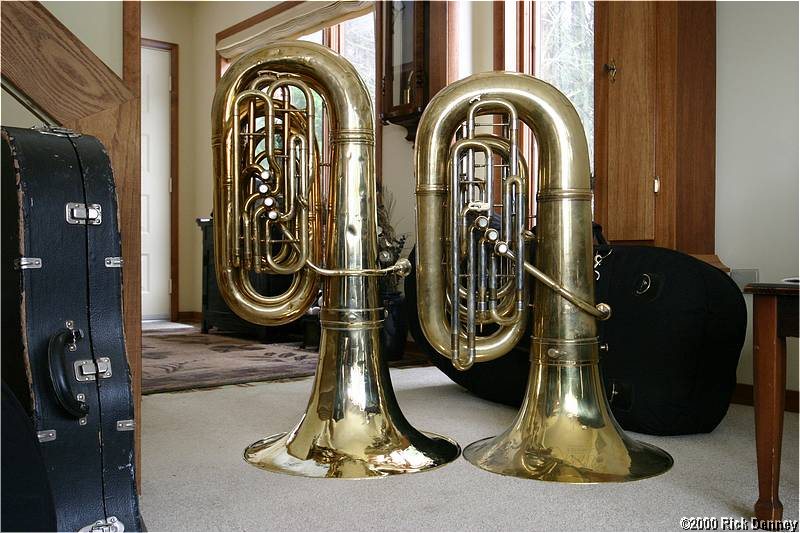
The old style 1241 is large only in bell diameter. Here is one next to a York Master, which is similar (even a hair smaller) to the 4/4 bm Symphonic 5500 from Nirschl.
Rick “avoiding size designation inflation” Denney
These users thanked the author Rick Denney for the post:
bort2.0 wrote: Sun Jan 16, 2022 6:27 pm
I think the idea of "5/4" is really messy. A PT-6, Willson 3050, Miraphone 1291, and Rudy Meinl 5/4 are all called 5/4 tubas. Like hell they are!
The MW2155 was billed as 5/4, and also as Warren Deck's quintet tuba of choice.
Keep the sizes in mind only as relative within the maker's lineup. Beyond that, it's nonsense.
A Miraphone 1291 actually IS a click bigger than a 186, which is 4/4. So of course they call it 5/4.
Same with the Rudy 5/4... it's one size bigger than their 4/4.
It's all so meaningless and silly, it makes my head spin. But I didn't make it, and we're stuck with it!
So you don't think a PT-6 or Willson 3050 are 5/4's? What are they then? Baby 6/4? They surely aren't 4/4's..
If you wanted to buy a truck at a Ford dealership, and there was no designation (Ranger, Maverick, F-150, 250, 350, 450...etc...) and you just said "Give me a Ford pickup, my buddy recommended them" would you not have a size in mind or care if they brought out a topkick F-750 with air brakes when you were thinking more of something you could park in your driveway like a 150? "Make&Modelslivesmatter"





 They surely aren't 4/4's..
