

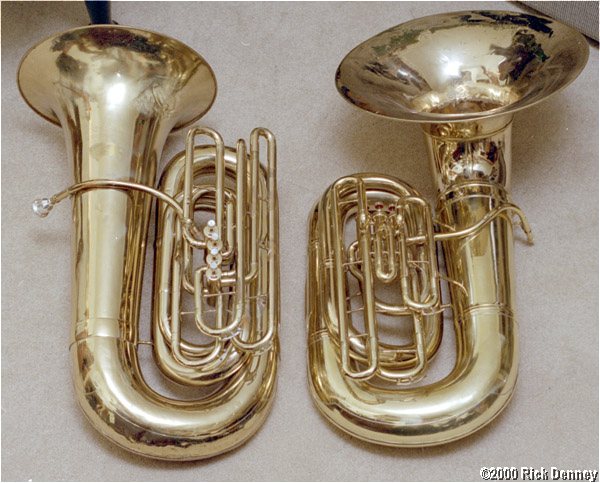
bloke wrote: Mon Jan 18, 2021 8:29 pm When a tuba is built 7 - 9 inches taller than another tuba (as the CSO York-style key-of-C lap sousaphones are often not much taller than three feet tall...37" tall seems common), the equivalent place in the expansion of the bugle of the taller one (compared to the shorter one) is necessarily going to occur (rather than "up top") around the area where the taller tuba's bottom bow ends...so the taller tuba's upper bow is going to necessarily be smaller diameter than the squatty CSO-style lap sousaphone's upper bow...though the taller one (where both straight bugles and laid out side-by-side) might be easily seen to sport just about as much overall bugle interior volume as the stubbier one.
Additionally, I doubt that an inch or two of bell pancake is going to add much interior volume (cubic inches/cubic centimeters/what-have-you) to a tuba.
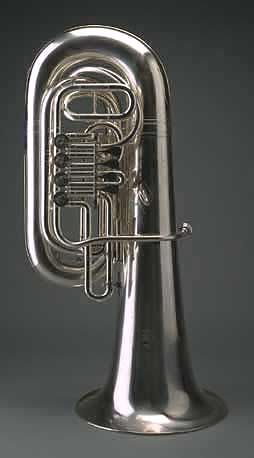
This Hirsbrunner kaiser B-tuba is 44 inches tall with a 19" bell and am 807" valveset bore , and
this Miraphone kaiser B-tuba is about 45-1/2 inches tall, with a 17-3/8" bell diameter and a .835" valveset bore
again: if you look towards the small ends of the bottom bows of these very tall tubas, that's roughly the same place (in the overall bugle taper) where the apex of the top bow occurs in the key-of-C lap-sousaphones.
These kaiser B-tubas (to me) resemble huge "blown out" Miraphone 186 or Meinl-Weston 20 tubas, whereas the CSO York-style key-of-C lap sousaphones (to me) more resemble huge "blown out" and "cut-to-C" King 2341 tubas.
SUMMARIZING: It's a mistake to compare the upper bow of a tall kaiser B-tuba to the upper bow of a CSO key-of-C York-style lap sousaphone, notice that the lap sousaphone's upper bow is fatter, and - from that - determine that the entire instrument is fatter, because to do so is to look at two DIFFERENT percentage locations of the overall length in the tapers of those two instruments.

Really glad you took the time to map this out.
I wanted to as well back when this discussion flared up in another post.
But then I thought “nah” and suggested that this could be a lovely new topic.
And look what’s become of this monster!
Entertaining for sure.
But in the end...???
A tuba is very conical and they’re all so different.
So determining different “sizes is, like has already been said (over and over), is like giving it any other name: useful within the scope of the manufacturers own products.
Any further than that might as well be taken with a grain of salt. Just a general indication.
Very general.
Now, we can all live with that, right?



 You walked right into that one