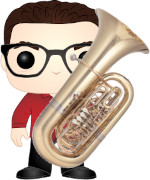

I sincerely hope for Dr Young to speak up here with a "news of my demise is greatly exaggerated" statement.
Barring that, here is what the a.i. offered in lieu of any obituaries
A traditional newspaper obituary for Dr. Frederick J. Young was not widely circulated or digitally preserved at the time of his passing in March 2021. This is relatively common for retired academics who maintained a private family life in their later years.
To honor his memory, the following synthesized tribute outlines his remarkable dual legacy in both music and engineering:
In Memoriam: Dr. Frederick J. Young (1930 – 2021)
Dr. Frederick Jesse Young, a brilliant mind who seamlessly bridged the worlds of advanced acoustic science and symphonic music, passed away peacefully in March 2021 at the age of 90.
Born in 1930, Dr. Young spent much of his life in western Pennsylvania, where he became a fixture in the local music community and a distinguished educator. He was an early alumnus of the Pittsburgh Youth Orchestra (playing from 1949 to 1954), an experience that set the stage for a lifelong devotion to the tuba. He went on to serve as the second tubist for the Pittsburgh Symphony Orchestra for two decades (1954–1974), performing under some of the world's most legendary conductors.
Beyond his prowess on the stage, Dr. Young was an accomplished scholar. He served as a Professor of Electrical Engineering at Carnegie Mellon University (CMU), where he specialized in electromagnetic fields, fluid dynamics, and musical acoustics. He was highly regarded by his students as a dedicated thesis advisor and author, publishing textbooks like A Course in Computational Electrostatic Field Theory.
Dr. Young famously combined his engineering expertise with his musical passion to challenge standard brass instrument designs. Disappointed by traditional manufacturing limitations, he famously designed a massive, custom double tuba (in BBb and EEE) and published papers through the Acoustical Society of America on optimizing brass intonation. He is perhaps most widely remembered by brass players for inventing the "Dr. Young" tuba mouthpiece, an unconventional design featuring a straight, untapered cylindrical backbore and a deep funnel cup intended to mirror the rich, fundamental tone of a French horn.
He spent his retirement years in Bradford, Pennsylvania, where he continued to publish scientific papers, consult on acoustics, and actively engage with musicians in online forums like TubeNet well into his later life. He is remembered by colleagues, former students, and the global brass community as an innovative thinker, a passionate performer, and a kind mentor.