
I emailed Warren about the Conn tuba about 10 years ago. He said the bell was 20" but the rest wasn't all that large. He and Bob Tucci both believed that the bottom bow was pretty commonly sized and probably the same thing that was used in a lot of other tubas from the time.
Other notes:
.735" bore
4th valve was 2-3 combo
5th valve was 1-3 combo
Low range G and Ab were as excellent as anything else he had played
Rest of the horn was a beast to play (his words)
The negatives far, far outweighed the positives
I didn't ask Warren about it, but I believe this was also the tuba where he replaced the original valve section with a valve section from an Alex 163 (and remember, the older Alex's were pretty hit or miss themselves). In the end, it was easier to play and play in tune, but it lost too much of the magic from the sound, so he eventually undid the work. (I think this is how the story goes.)
4/4 Tubas in Professional Symphony Recordings
Forum rules
This section is for posts that are directly related to performance, performers, or equipment. Social issues are allowed, as long as they are directly related to those categories. If you see a post that you cannot respond to with respect and courtesy, we ask that you do not respond at all.
This section is for posts that are directly related to performance, performers, or equipment. Social issues are allowed, as long as they are directly related to those categories. If you see a post that you cannot respond to with respect and courtesy, we ask that you do not respond at all.
-
bort2.0

- Posts: 6025
- Joined: Thu Aug 13, 2020 9:13 am
- Location: Minneapolis
- Has thanked: 471 times
- Been thanked: 1286 times
Re: 4/4 Tubas in Professional Symphony Recordings
My brain hurts just thinking about that.
Todd Morgan
Rudy Meinl 4/4 CC
Besson 995
Meinl Weston 2145
Mr. P 5.0
Rudy Meinl 4/4 CC
Besson 995
Meinl Weston 2145
Mr. P 5.0
Re: 4/4 Tubas in Professional Symphony Recordings
I can clarify a little on the Conn. When I bought it, it still had the Alex valve section on it. For me it had horrendous back pressure--I couldn't play it at all when I first saw it. But Warren had kept the original valve section, and so Matt Walters rebuilt the horn with the original valve section. There are still artifacts of the horn's prior life, such as remnants of some original bracing (very heavy duty), the detachable connection of the leadpipe Warren had made, etc; that would have been hugely expensive to restore to fully original.
Warren told me that he bought the horn from Michael Lind and got it when the orchestra was on tour; and that he played the next concert on it. I cannot imagine doing that, unless maybe if only New World was on the program.
Unfortunately the original recording bell, that was with the horn when it resided with Arnold Jacobs for a while, became separated from the horn.
The horn can put out a lot of sound without breaking up.
Mike
Re: 4/4 Tubas in Professional Symphony Recordings
On another topic from above, Jonathan Fowler plays a 163 in the Columbus Symphony. When I first moved here a couple of years ago I was struck with his gorgeous sound, and the remarkable blend with both the basses and the horns and trombones. I had not heard that live since Dave Kirk arrived in Houston; and I had forgotten how special an Alex could sound.
Columbus has a number of big programs this year, including Mahler 5; and a performance with Tchaikovsky 5 in Carnegie Hall--worth hearing if you are in the area.
Mike
Columbus has a number of big programs this year, including Mahler 5; and a performance with Tchaikovsky 5 in Carnegie Hall--worth hearing if you are in the area.
Mike

-
russiantuba

- Posts: 967
- Joined: Thu Aug 13, 2020 8:04 am
- Location: Circleville, Ohio
- Has thanked: 79 times
- Been thanked: 387 times
- Contact:
Re: 4/4 Tubas in Professional Symphony Recordings
I just learned a couple of weeks ago that you are in the Columbus area. I should probably set up some time to play some tubas!
Dr. James M. Green
Lecturer in Music--Ohio Northern University
Adjunct Professor of Music--Ohio Christian University
Gronitz PF 125
Miraphone 1291CC
Miraphone Performing Artist
www.russiantuba.com
Lecturer in Music--Ohio Northern University
Adjunct Professor of Music--Ohio Christian University
Gronitz PF 125
Miraphone 1291CC
Miraphone Performing Artist
www.russiantuba.com
Re: 4/4 Tubas in Professional Symphony Recordings
I just saw this tuba on Tuesday at the National Music Museum in Vermillion, SD. Here's what the placard said:arpthark wrote: Fri Aug 21, 2026 7:12 am There's also a Conn/Geib CC on horn-u-copia that looks even larger:
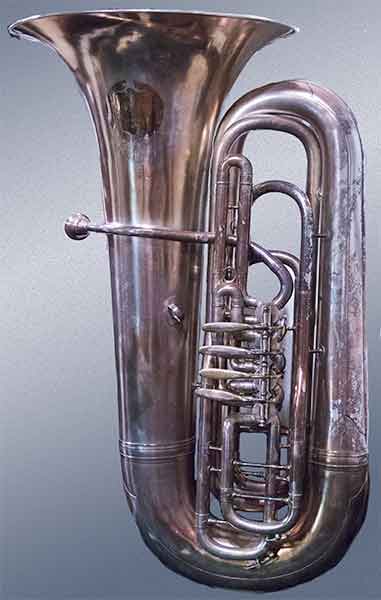
To me this tuba looked like a 4/4.Tuba, C
C.G. Conn
Elkhart, Indiana, ca. 1908-1909
Fred Geib, Sr. played this custom-made tuba on many of the earliest American recordings of classical orchestras.
Geib preferred rotary valves, so Conn outfitted this tuba with them. It is one of only a handful of rotary-valve instruments made by Conn.
Gift of S. Saffir, 2001
NMM 14563
Willson 2900 (B♭)
Yamaha YEB-632IIS (EE♭)
Willson 3400S-FA5 (EE♭)
Willson 3060-FA5 (CC)
B&S MRP-P (CC)
Yamaha YEB-632IIS (EE♭)
Willson 3400S-FA5 (EE♭)
Willson 3060-FA5 (CC)
B&S MRP-P (CC)
-
arpthark

- Posts: 6713
- Joined: Mon Aug 24, 2020 4:25 pm
- Location: near the Submarine Capital of the World
- Has thanked: 2175 times
- Been thanked: 2381 times
Re: 4/4 Tubas in Professional Symphony Recordings
Very interesting! It's so hard to tell how large a tuba is through 2D pictures.je wrote: Fri Aug 21, 2026 12:35 pmI just saw this tuba on Tuesday at the National Music Museum in Vermillion, SD. Here's what the placard said:arpthark wrote: Fri Aug 21, 2026 7:12 am There's also a Conn/Geib CC on horn-u-copia that looks even larger:
To me this tuba looked like a 4/4.Tuba, C
C.G. Conn
Elkhart, Indiana, ca. 1908-1909
Fred Geib, Sr. played this custom-made tuba on many of the earliest American recordings of classical orchestras.
Geib preferred rotary valves, so Conn outfitted this tuba with them. It is one of only a handful of rotary-valve instruments made by Conn.
Gift of S. Saffir, 2001
NMM 14563

Re: 4/4 Tubas in Professional Symphony Recordings
The Toby Hanks Holton is an interesting and seemingly unique tuba. It dates to 1914-15, and is probably best characterized as 3/4 tuba, as it is quite small-- smaller, I'm sure, than a 5J, though I don't have one here to compare. I have not seen even pictures of a Holton of this size.
Toby used the horn for number of years with the NYBQ, and I imagine for other purposes also, but I don't know that. I first saw the instrument when the NYBQ came to Sam Houston University, outside Houston, in the early 70’s, and I was highly enamored with the horn. For some reason, Toby actually let me play it for a couple of minutes.
The horn is quite agile, with a nice clear sound, and very good intonation, overall. I would not have hedged on the intonation, but prior to Toby the horn was owned by a dear friend of mine, Will Traphagan. Will took Harvey's seat in the Army Field Band, when Harvey left; and later went on to play and teach professionally for many years in the Boston area. And Will, who had very high expectations for his instruments, told me he sold the tuba because he didn't like dealing with a (slightly) out of tune F sharp. Will bought the tuba from Walter Sear, and later sold it through him, presumably directly to Toby. A couple of friends have borrowed the instrument for performances, and thought it played very well. The sound even projects better than one might expect for such a compact one
Unfortunately, over the years, Toby made some alterations, including a funky fifth valve, and an even funkier lead pipe to accommodate the fifth valve. Toby eventually sold the tuba to a well-known professional, and then the horn appeared a couple of years later (maybe 12-14 years ago) on consignment at the Army Band Conference. With the alterations, the instrument was barely, if at all, really playable. It was far from the instrument it once was; but fortunately I knew what it once was. So I purchased the instrument and tuba whisper Matt Walters did his magic, removing the funky fifth valve in the couple of other alterations, and making a new appropriately configured leadpipe. Surprisingly one feature that stayed with the tuba were the very small diameter Holton finger buttons. These days, if someone were going to play the horn seriously at length, those would probably be replaced with much larger buttons.
Oddly there are no records from Holton regarding the instrument (and the same goes for two other unusual Holtons-- both Jack Richardson models). A friend who had access to the records a number of years ago check the serial numbers for the three instruments but none were identified. So we have no way of knowing if it was specially built for someone.
-
catgrowlB
- Posts: 438
- Joined: Tue Jun 13, 2023 8:46 pm
- Has thanked: 413 times
- Been thanked: 175 times
Re: 4/4 Tubas in Professional Symphony Recordings
I wonder if the Toby Hanks Holton tuba is a CC version of this tuba: https://www.tubaforum.net/viewtopic.php?t=10343
It's the pic York-aholic posted. Is that Fred Geib in the bottom-right corner?
It's the pic York-aholic posted. Is that Fred Geib in the bottom-right corner?
-
York-aholic
- Posts: 1931
- Joined: Thu Aug 13, 2020 10:39 pm
- Location: SoCal
- Has thanked: 2570 times
- Been thanked: 740 times
Re: 4/4 Tubas in Professional Symphony Recordings

- These users thanked the author York-aholic for the post (total 3):
- tubatodd (Sun Aug 23, 2026 12:18 pm) • J-B (Sun Aug 23, 2026 5:25 pm) • arpthark (Mon Aug 24, 2026 6:24 am)
Some old Yorks, Martins, and perhaps a King rotary valved CC

Re: 4/4 Tubas in Professional Symphony Recordings
I studied with Mr. Torchinsky. He was the Principal Tuba of the Philadelphia Orchestra during the 1950's, 1960's and very early 1970's. He played and recorded under Maestro Eugene Ormandy. Mr. Torchinsky's tuba was a yellow brass, 4 rotary valved King CC tuba. He said that he played his King during his whole NBC Symphony and Philadelphia Orchestra careers. Though he never mentioned owning a Miraphone 184, he may have picked one up after he retired from playing and began teaching a University of Michigan.Mary Ann wrote: Thu Aug 20, 2026 9:06 am Somewhere someone said that Torchinsky played the 184 I used to own, in whatever orchestra it was that he played in. I have no idea if that is true. That might have been Tony Clements who said that, many years ago. I bought that 184 from someone he had sold it to, and he contacted me to say that was a very fine example of a 184. Which it was.
- These users thanked the author hbcrandy for the post (total 2):
- York-aholic (Sat Aug 22, 2026 7:27 am) • Mary Ann (Sat Aug 22, 2026 8:32 am)
Randy Harrison
Retired Proprietor, Harrison Brass
Retired Instructor of Applied Brass Performance,
Maryland Conservatory of Music
Retired Proprietor, Harrison Brass
Retired Instructor of Applied Brass Performance,
Maryland Conservatory of Music
-
UncleBeer

- Posts: 742
- Joined: Thu Aug 13, 2020 8:37 am
- Has thanked: 122 times
- Been thanked: 514 times
Re: 4/4 Tubas in Professional Symphony Recordings
I got to play that horn several times in Avery Fisher with Warren out front (checking on his modifications in the hall; No pressure, right?Mikelynch wrote: Fri Aug 21, 2026 9:38 am I can clarify a little on the Conn. When I bought it, it still had the Alex valve section on it. For me it had horrendous back pressure--I couldn't play it at all when I first saw it. But Warren had kept the original valve section, and so Matt Walters rebuilt the horn with the original valve section. There are still artifacts of the horn's prior life, such as remnants of some original bracing (very heavy duty), the detachable connection of the leadpipe Warren had made, etc; that would have been hugely expensive to restore to fully original.
Warren told me that he bought the horn from Michael Lind and got it when the orchestra was on tour; and that he played the next concert on it. I cannot imagine doing that, unless maybe if only New World was on the program.
Unfortunately the original recording bell, that was with the horn when it resided with Arnold Jacobs for a while, became separated from the horn.
The horn can put out a lot of sound without breaking up.
Mike
 ) That horn was tough to play! Lots of quirks, not the least of which was a B natural on top of the staff which refused to slot at all. Yikes.
- These users thanked the author UncleBeer for the post:
- York-aholic (Sat Aug 22, 2026 7:28 am)
Re: 4/4 Tubas in Professional Symphony Recordings
Having had the opportunity to spend time with the Conn in its original configuration, I find some of the comments being made about it interesting. In my experience, the tuba was relatively easy to play. My primary concern was simply that the valve configuration did not conform to what most players would consider modern standards today.
To my understanding, the instrument was based on the Sander tuba that Fred Geib played, but with a number of significant improvements. Warren spent a considerable amount of time tinkering with the instrument and making adjustments so that it would work for him in the NYPO. I’d imagine putting the Alexander valve section and incredibly large leadpipes on it would make it very difficult to control and you can hear it when he played it yet he made it work. It is certainly possible that players who did not possess that particular skill set or familiarity with the instrument may have found it more difficult to play.
However, after the extensive work Matt Walters performed during the reconstruction, most, if not all, of those concerns no longer exist. The high D has always been one of the more troublesome notes on this particular instrument, and even that is now considerably more manageable.
Warren Deck may have described the tuba as difficult to play when he owned it, but I am not confident that Warren has played the instrument since its reconstruction. In its current form, I would not characterize it as difficult to play at all.
Last edited by Porky on Sun Aug 23, 2026 9:40 pm, edited 1 time in total.
Re: 4/4 Tubas in Professional Symphony Recordings
I played the Conn once after a lesson with Deck, when it still had the original valve section and the unusually large leadpipe. My immediate impression was that the tuba felt like it had been built for someone extremely tall with a large chest and a huge air capacity. The amount of sound that instrument could produce was unbelievable. I actually thought it was a lot of fun to play, although in the back of my mind I kept wondering how it might have played with the original leadpipe or with one of the leadpipes Michael Lind had Alexander make.
Porky also brings up a great point. I remember Warren talking about the D being problematic, particularly in Copland 3. Warren eventually went larger with the setup because he wanted more breadth and weight out of the instrument, somewhat closer to what he was getting from the Holton.
When I heard Warren play the Conn shortly after he first got it, still in its original form, I thought it sounded magnificent especially in the live Wagner. It had an enormous presence and a very distinctive sound.
-
Sousaswag
- Posts: 1113
- Joined: Thu Aug 20, 2020 1:55 pm
- Has thanked: 26 times
- Been thanked: 506 times
Re: 4/4 Tubas in Professional Symphony Recordings
I believe Doug Tornquist has used a HB-2P on hundreds of movie soundtracks in LA.
Probably uses that Hb-2P in Long Beach, too.
Probably uses that Hb-2P in Long Beach, too.
B&S PT-6P
Meinl Weston "6465"
Meinl Weston 2141
Willson 3200RZ-5
Holton 345
Holton 350 (For sale)
Meinl Weston "6465"
Meinl Weston 2141
Willson 3200RZ-5
Holton 345
Holton 350 (For sale)
-
russiantuba
- Posts: 967
- Joined: Thu Aug 13, 2020 8:04 am
- Location: Circleville, Ohio
- Has thanked: 79 times
- Been thanked: 387 times
- Contact:
Re: 4/4 Tubas in Professional Symphony Recordings
Didn’t Chris Hall with the Metropolitan Opera also use a HB 2P or similar horn for many operas?
- These users thanked the author russiantuba for the post:
- tubatodd (Mon Aug 24, 2026 4:25 am)
Dr. James M. Green
Lecturer in Music--Ohio Northern University
Adjunct Professor of Music--Ohio Christian University
Gronitz PF 125
Miraphone 1291CC
Miraphone Performing Artist
www.russiantuba.com
Lecturer in Music--Ohio Northern University
Adjunct Professor of Music--Ohio Christian University
Gronitz PF 125
Miraphone 1291CC
Miraphone Performing Artist
www.russiantuba.com
-
davidgilbreath

- Posts: 46
- Joined: Thu Aug 13, 2020 9:25 am
- Location: My Old Kentucky Home in Marietta, GA (or little England way beyond Wales)
- Has thanked: 209 times
- Been thanked: 14 times
Re: 4/4 Tubas in Professional Symphony Recordings
This response could certainly be considered "lost in the weeds", but I've harvested wonderful nuggets from this group (began lurking on the old board in 1998 before migrating to this iteration). Sometime during my 1970-75 UK days, I bought the 1965 Philips recording of Brucker's 4th by the Concertgebouw Orchestra which had Donald Blakeslee playing (reportedly) an Alex 163. Recording quality was remarkable in its clarity and Mr. Blakeslee was spot on, gorgeous and well-controlled full sound.
- These users thanked the author davidgilbreath for the post (total 2):
- arpthark (Mon Aug 24, 2026 7:24 am) • York-aholic (Mon Aug 24, 2026 9:56 pm)
". . . and loudly he played . . . "
David Gilbreath
1925 Conn New Wonder Monster Front Action BBb
c. 1938 York 716 5/4 BBb 4v

David Gilbreath
1925 Conn New Wonder Monster Front Action BBb
c. 1938 York 716 5/4 BBb 4v
Re: 4/4 Tubas in Professional Symphony Recordings
Perhaps I am really late to the game. But I've noticed just about every artist has many, if not EVERY, album of theirs uploaded to Youtube to stream for free. Just look under releases. Sure you can search and find most anything on Youtube. That wasn't the point. The point is the artist has the album uploaded and nicely organized into album playlists.
Los Angeles Philharmonic
https://www.youtube.com/@laphil/releases
Los Angeles Philharmonic
https://www.youtube.com/@laphil/releases
- These users thanked the author tubatodd for the post:
- York-aholic (Mon Aug 24, 2026 9:57 pm)
Todd Morgan
Rudy Meinl 4/4 CC
Besson 995
Meinl Weston 2145
Mr. P 5.0
Rudy Meinl 4/4 CC
Besson 995
Meinl Weston 2145
Mr. P 5.0