
I got to play American in Paris this past weekend with a pro orchestra in the Cincinnati area. I got the golden opportunity to perform this piece in Severance Hall (band version, but had very similar parts), and when doing so, I got to work on it with my professor Jim Akins. Jim was a personal friend of Earl Wild, who worked with Gershwin. So, when the conductor tried to take the trumpet solo section swung, and I mentioned that when I was adding a hint of swing to the tuba solo, Jim left his office, went to the band office to talk to the conductor about how Gershwin didn't want it swung, and later that day in band, the conductor (who was very hard to convince on opinions) changed his opinion and we did it straight.
What Gene says on his orchestral excerpt CD on The American in Paris solo is pretty accurate (not what he played on the recording CSO did under Levine)--it shouldn't be overdone. No other instrument has grace notes, growls, or scoops in their solos, but it seems like tubas over "jazz" it up. In the "critical edition" I played this last weekend, it had notes how an early score had the tuba solo in the bassoon part and an early recording used bass clarinet. Lets play this piece as Gershwin wrote it, somewhat free, but not over-stylized, before its given to the bassoon or bass clarinets...
The American in Paris Solo--Some Thoughts
Forum rules
This section is for posts that are directly related to performance, performers, or equipment. Social issues are allowed, as long as they are directly related to those categories. If you see a post that you cannot respond to with respect and courtesy, we ask that you do not respond at all.
This section is for posts that are directly related to performance, performers, or equipment. Social issues are allowed, as long as they are directly related to those categories. If you see a post that you cannot respond to with respect and courtesy, we ask that you do not respond at all.
-
russiantuba

- Posts: 968
- Joined: Thu Aug 13, 2020 8:04 am
- Location: Circleville, Ohio
- Has thanked: 79 times
- Been thanked: 388 times
- Contact:
The American in Paris Solo--Some Thoughts
- These users thanked the author russiantuba for the post:
- Inkin (Fri May 01, 2026 9:21 am)
Dr. James M. Green
Lecturer in Music--Ohio Northern University
Adjunct Professor of Music--Ohio Christian University
Gronitz PF 125
Miraphone 1291CC
Miraphone Performing Artist
www.russiantuba.com
Lecturer in Music--Ohio Northern University
Adjunct Professor of Music--Ohio Christian University
Gronitz PF 125
Miraphone 1291CC
Miraphone Performing Artist
www.russiantuba.com
-
bloke

- Mid South Music
- Posts: 26021
- Joined: Thu Aug 13, 2020 8:55 am
- Location: western Tennessee - near Memphis
- Has thanked: 5527 times
- Been thanked: 6453 times
Re: The American in Paris Solo--Some Thoughts
It's really simple:
- only slightly slower than the previous tempo (it's a simple melody line. Just play it.)
- simple Marcel Tabuteau style phrasing (up is up and down is down)
- no note bending, no "jazz' articulations, as none of this is indicated in the music and nothing previous indicated this in the other instruments playing of the same melody
- it's not a big deal and it's just a little tongue and cheek thing where it's funny enough that - of all instruments - it's the tuba that finishes off this section. These days, we take ourselves far too seriously, and frankly more seriously than do most orchestra patrons and music lovers. (Harvey Phillips did a whole lot to get tuba players to take themselves more seriously and to up their game, but he himself had had a huge sense of humor that often didn't come through when he spoke to groups of tuba players. Since forever and forever, a huge percentage of musical jokes involve a tuba, and rightfully so. "Hamming up" this solo is analogous to when a 5-year-old steps out in front of a group of adults, tells a joke, gets a laugh, and then tells it again and again - hoping to get the same laugh they got the first time. The fact that the five-year-old told it is mostly what made the joke funny, and not the joke itself - which needed no embellishment.)
========================
Once in the past - in a final round, I auditioned for a mediocre (ignoramus) music director, who asked me to play the passage a second time more "jazzy". I play a lot of jazz jobs (I doubt that I've played thousands during my life, but I'm absolutely sure I've played a thousand), but I couldn't bring myself to add much "jazz" to that passage but barely enough for him to notice. I was offered the per service job. I looked at my line up of engagements already scheduled for that year, and subsequently declined to accept. I don't believe I missed out on much. (When playing in an ensemble, and - unless the dough is really attractive - one finds themselves raising their eyebrows and looking to the ceiling fairly often, it might be more beneficial to just stay at home and work on one's individual skills - upping one's game. As much time as we spend in symphony orchestras sitting there not playing - and as short as are our human lives - those long expanses of sitting there not playing at least need to be learning experiences.)
- only slightly slower than the previous tempo (it's a simple melody line. Just play it.)
- simple Marcel Tabuteau style phrasing (up is up and down is down)
- no note bending, no "jazz' articulations, as none of this is indicated in the music and nothing previous indicated this in the other instruments playing of the same melody
- it's not a big deal and it's just a little tongue and cheek thing where it's funny enough that - of all instruments - it's the tuba that finishes off this section. These days, we take ourselves far too seriously, and frankly more seriously than do most orchestra patrons and music lovers. (Harvey Phillips did a whole lot to get tuba players to take themselves more seriously and to up their game, but he himself had had a huge sense of humor that often didn't come through when he spoke to groups of tuba players. Since forever and forever, a huge percentage of musical jokes involve a tuba, and rightfully so. "Hamming up" this solo is analogous to when a 5-year-old steps out in front of a group of adults, tells a joke, gets a laugh, and then tells it again and again - hoping to get the same laugh they got the first time. The fact that the five-year-old told it is mostly what made the joke funny, and not the joke itself - which needed no embellishment.)
========================
Once in the past - in a final round, I auditioned for a mediocre (ignoramus) music director, who asked me to play the passage a second time more "jazzy". I play a lot of jazz jobs (I doubt that I've played thousands during my life, but I'm absolutely sure I've played a thousand), but I couldn't bring myself to add much "jazz" to that passage but barely enough for him to notice. I was offered the per service job. I looked at my line up of engagements already scheduled for that year, and subsequently declined to accept. I don't believe I missed out on much. (When playing in an ensemble, and - unless the dough is really attractive - one finds themselves raising their eyebrows and looking to the ceiling fairly often, it might be more beneficial to just stay at home and work on one's individual skills - upping one's game. As much time as we spend in symphony orchestras sitting there not playing - and as short as are our human lives - those long expanses of sitting there not playing at least need to be learning experiences.)
-
UncleBeer

- Posts: 742
- Joined: Thu Aug 13, 2020 8:37 am
- Has thanked: 122 times
- Been thanked: 514 times
Re: The American in Paris Solo--Some Thoughts
This. In my old EU orchestra when they'd get their hands on something they considered "jazzy", they'd conjure up all sorts of crazy interpretations: fall-offs on every note, modifying parts at-will, and that stupid "growl" thingy. Ugh.bloke wrote: Fri May 01, 2026 8:48 am - no note bending, no "jazz' articulations, as none of this is indicated in the music and nothing previous indicated this in the other instruments playing of the same melody

-
the elephant

- Posts: 5118
- Joined: Thu Aug 13, 2020 8:39 am
- Location: 32°50'57.0"N 90°24'34.9"W
- Has thanked: 3272 times
- Been thanked: 2624 times
Re: The American in Paris Solo--Some Thoughts
Play the ink. There are no indicated bends, doits, growls, or other goofy stuff. There is no indication to swing. There are no chord changes. It is not a "solo" in that sense. It is a continuation of the violin solo and needs to be played in the same style to continue what Gershwin wrote. It is not a tuba cadenza.
If he had wanted anything other than what he wrote, he would have written it into the part. Play only what is on the page; this piece is not jazz. I heard one sadsack play the whole thing down an octave. I do not understand why people do stuff like this.
If he had wanted anything other than what he wrote, he would have written it into the part. Play only what is on the page; this piece is not jazz. I heard one sadsack play the whole thing down an octave. I do not understand why people do stuff like this.
- These users thanked the author the elephant for the post (total 2):
- UncleBeer (Fri May 01, 2026 10:32 am) • Inkin (Fri May 01, 2026 1:13 pm)
 HO, HO, HO! Santa thinks you're funny!
-
arpthark

- Posts: 6716
- Joined: Mon Aug 24, 2020 4:25 pm
- Location: near the Submarine Capital of the World
- Has thanked: 2176 times
- Been thanked: 2382 times
Re: The American in Paris Solo--Some Thoughts
I have perfected the historically-accurate ophicleide interpretation of this solo. That’s actually what Gershwin intended (had he been born 100 years earlier).
- These users thanked the author arpthark for the post (total 3):
- gocsick (Fri May 01, 2026 1:19 pm) • York-aholic (Fri May 01, 2026 1:32 pm) • thedancingsousa (Sat May 02, 2026 7:02 pm)

-
Rick Denney

- Resident Genius
- Posts: 1164
- Joined: Thu Aug 13, 2020 8:24 am
- Has thanked: 83 times
- Been thanked: 452 times
Re: The American in Paris Solo--Some Thoughts
I see it as a somewhat mournful or reflective end to an extended passage, and when I played it I let the tempo lag a bit with tenutos here and there, but didn’t do anything else.
Rick “not humorous” Denney
Rick “not humorous” Denney
-
Colby Fahrenbacher
- Posts: 292
- Joined: Thu Aug 13, 2020 5:51 pm
- Has thanked: 29 times
- Been thanked: 89 times
Re: The American in Paris Solo--Some Thoughts
In Feburary 2026, Mark Clague, the editor-in-chief of the George and Ira Gershwin Critical Edition included this comment in the release of the new critical edition of "American in Paris":
"Each edition* restores Gershwin’s original orchestration and articulation, clarifies and corrects errors
and ambiguities in notation, and removes spurious additions and changes made for the popularly
known arrangement “revised” by Frank Campbell-Watson published in the 1940s. Until now, the
Campbell-Watson revision is the only edition to which ensembles and audiences have had access."
I haven't seen the new edition, and I very much doubt that the tuba solo was affected much, if at all, by these corrections, so I'm sure all of the comments about Gershwin not intending for the tuba to take a four bar improv solo are accurate. However, I squirm a bit anytime someone takes a hard stance on "composer intentions" though. At least in this case, we've spent ~80 years performing an "arrangement" of American in Paris that appears to have been met with a fair amount of derision from scholars. From what I've seen, the Gershwin Critical Edition don't consider the Campbell-Watson arrangement particularly true to Gershwin's intentions (although to be fair, they ARE trying to sell us a new edition, so that's to be expected). This certainly isn't the only published work that has deviated from the composer's original manuscripts/intentions by an arranger, copyist, engraver, or publisher.
* "each edition" is a reference to the two different endings they have made available, one "uncut" and one "final" that incorporates five cuts in Gershwin's manuscript that enabled the 1929 Victor Orchestra recording to fit on four sides of two 78-rpm disks.
"Each edition* restores Gershwin’s original orchestration and articulation, clarifies and corrects errors
and ambiguities in notation, and removes spurious additions and changes made for the popularly
known arrangement “revised” by Frank Campbell-Watson published in the 1940s. Until now, the
Campbell-Watson revision is the only edition to which ensembles and audiences have had access."
I haven't seen the new edition, and I very much doubt that the tuba solo was affected much, if at all, by these corrections, so I'm sure all of the comments about Gershwin not intending for the tuba to take a four bar improv solo are accurate. However, I squirm a bit anytime someone takes a hard stance on "composer intentions" though. At least in this case, we've spent ~80 years performing an "arrangement" of American in Paris that appears to have been met with a fair amount of derision from scholars. From what I've seen, the Gershwin Critical Edition don't consider the Campbell-Watson arrangement particularly true to Gershwin's intentions (although to be fair, they ARE trying to sell us a new edition, so that's to be expected). This certainly isn't the only published work that has deviated from the composer's original manuscripts/intentions by an arranger, copyist, engraver, or publisher.
* "each edition" is a reference to the two different endings they have made available, one "uncut" and one "final" that incorporates five cuts in Gershwin's manuscript that enabled the 1929 Victor Orchestra recording to fit on four sides of two 78-rpm disks.
Former Tubist, USAF Bands
-
Colby Fahrenbacher
- Posts: 292
- Joined: Thu Aug 13, 2020 5:51 pm
- Has thanked: 29 times
- Been thanked: 89 times
Re: The American in Paris Solo--Some Thoughts
For anyone who's interested in the Clague edition, I know the Cincinnati Symphony was involved in the editing process for it, and there is a live recording of it from 2024 on Spotify.
Former Tubist, USAF Bands
-
arpthark
- Posts: 6716
- Joined: Mon Aug 24, 2020 4:25 pm
- Location: near the Submarine Capital of the World
- Has thanked: 2176 times
- Been thanked: 2382 times
Re: The American in Paris Solo--Some Thoughts
100% agreed. I had some really interesting courses in grad school that tackled this topic.Colby Fahrenbacher wrote: Fri May 01, 2026 11:05 am However, I squirm a bit anytime someone takes a hard stance on "composer intentions" though.
-
bort2.0

- Posts: 6025
- Joined: Thu Aug 13, 2020 9:13 am
- Location: Minneapolis
- Has thanked: 471 times
- Been thanked: 1286 times
Re: The American in Paris Solo--Some Thoughts
My pet peeve -- lingering too much on the D# --> E and C# --> D.
Re: The American in Paris Solo--Some Thoughts
My opinion boils down to: Then every recording and performance would be identical. If you could even figure out the intention. No one thinks every Shakespeare performance needs to be the same. The only performance that has ever been perfected such that it can’t be done differently is Robert Preston’s Harold Hill in the Music Man. I will die on this hill.arpthark wrote: Fri May 01, 2026 11:34 am100% agreed. I had some really interesting courses in grad school that tackled this topic.Colby Fahrenbacher wrote: Fri May 01, 2026 11:05 am However, I squirm a bit anytime someone takes a hard stance on "composer intentions" though.
-
bort2.0
- Posts: 6025
- Joined: Thu Aug 13, 2020 9:13 am
- Location: Minneapolis
- Has thanked: 471 times
- Been thanked: 1286 times
Re: The American in Paris Solo--Some Thoughts
It's up to the conductor, not the tuba player. I think we definitely get the first shot at playing at the way we want to play it, but if there's disagreement... If you want to play it, you'll Play it the way the conductor wants it.tubanh84 wrote: Fri May 01, 2026 11:55 amMy opinion boils down to: Then every recording and performance would be identical. If you could even figure out the intention. No one thinks every Shakespeare performance needs to be the same. The only performance that has ever been perfected such that it can’t be done differently is Robert Preston’s Harold Hill in the Music Man. I will die on this hill.arpthark wrote: Fri May 01, 2026 11:34 am100% agreed. I had some really interesting courses in grad school that tackled this topic.Colby Fahrenbacher wrote: Fri May 01, 2026 11:05 am However, I squirm a bit anytime someone takes a hard stance on "composer intentions" though.
For that matter, some of the variations that we've all heard, maybe something that the tuba player themselves found cringey, but it's what they had to do. Not always, but 100% possible.
Maestro

- These users thanked the author bort2.0 for the post (total 2):
- tubanh84 (Fri May 01, 2026 12:35 pm) • MN_TimTuba (Fri May 01, 2026 12:39 pm)
Re: The American in Paris Solo--Some Thoughts
This is a good point. I think about it a lot when it's a tempo issue. The big one to me is the solo in the first movement of Mahler 5. Any time it's either too rushed or too lugubrious, I instantly mentally blame the conductor. My head doesn't always go there when it's a style issue. But it absolutely could be the conductor.bort2.0 wrote: Fri May 01, 2026 12:19 pm
It's up to the conductor, not the tuba player. I think we definitely get the first shot at playing at the way we want to play it, but if there's disagreement... If you want to play it, you'll Play it the way the conductor wants it.
For that matter, some of the variations that we've all heard, maybe something that the tuba player themselves found cringey, but it's what they had to do. Not always, but 100% possible.
Maestro
-
1 Ton Tommy
- Posts: 175
- Joined: Thu Mar 20, 2025 11:01 am
- Has thanked: 40 times
- Been thanked: 58 times
Re: The American in Paris Solo--Some Thoughts
Could someone please post a link to this solo.
I am in rehearsal of American in Paris Suite -- arr. John Whitney; with one week and the dress to go.
There may be remanents of the tuba solo of which you are speaking. I'm not generally a fan of our conductor/music director's choice of "arrangements" and this is no exception. And I don't get to choose. There is lots of staccato market "quasi pizz." and other percussive markings. I'm playing the Mammoth on its stand in deference to my back and I don't think it's a good match based on the markings and I'd like to hear the original solo.
I am in rehearsal of American in Paris Suite -- arr. John Whitney; with one week and the dress to go.
There may be remanents of the tuba solo of which you are speaking. I'm not generally a fan of our conductor/music director's choice of "arrangements" and this is no exception. And I don't get to choose. There is lots of staccato market "quasi pizz." and other percussive markings. I'm playing the Mammoth on its stand in deference to my back and I don't think it's a good match based on the markings and I'd like to hear the original solo.
Community orchestra member
1918 Martin Eb 4V, still played after 50 years
Martin Mammoth 4V, BBb
Wilson 3400 5V EEb
Assorted trumpets/cornet
Antique, Pan American trombone
1918 Martin Eb 4V, still played after 50 years
Martin Mammoth 4V, BBb
Wilson 3400 5V EEb
Assorted trumpets/cornet
Antique, Pan American trombone
-
arpthark
- Posts: 6716
- Joined: Mon Aug 24, 2020 4:25 pm
- Location: near the Submarine Capital of the World
- Has thanked: 2176 times
- Been thanked: 2382 times
Re: The American in Paris Solo--Some Thoughts
1 Ton Tommy wrote: Fri May 01, 2026 12:41 pm Could someone please post a link to this solo.
I am in rehearsal of American in Paris Suite -- arr. John Whitney; with one week and the dress to go.
There may be remanents of the tuba solo of which you are speaking. I'm not generally a fan of our conductor/music director's choice of "arrangements" and this is no exception. And I don't get to choose. There is lots of staccato market "quasi pizz." and other percussive markings. I'm playing the Mammoth on its stand in deference to my back and I don't think it's a good match based on the markings and I'd like to hear the original solo.

Timestamped link to Chicago/Levine:
- These users thanked the author arpthark for the post:
- 1 Ton Tommy (Sun May 03, 2026 10:26 am)
-
russiantuba
- Posts: 968
- Joined: Thu Aug 13, 2020 8:04 am
- Location: Circleville, Ohio
- Has thanked: 79 times
- Been thanked: 388 times
- Contact:
Re: The American in Paris Solo--Some Thoughts
Colby Fahrenbacher wrote: Fri May 01, 2026 11:05 am In Feburary 2026, Mark Clague, the editor-in-chief of the George and Ira Gershwin Critical Edition included this comment in the release of the new critical edition of "American in Paris":
"Each edition* restores Gershwin’s original orchestration and articulation, clarifies and corrects errors
and ambiguities in notation, and removes spurious additions and changes made for the popularly
known arrangement “revised” by Frank Campbell-Watson published in the 1940s. Until now, the
Campbell-Watson revision is the only edition to which ensembles and audiences have had access."
I haven't seen the new edition, and I very much doubt that the tuba solo was affected much, if at all, by these corrections, so I'm sure all of the comments about Gershwin not intending for the tuba to take a four bar improv solo are accurate. However, I squirm a bit anytime someone takes a hard stance on "composer intentions" though. At least in this case, we've spent ~80 years performing an "arrangement" of American in Paris that appears to have been met with a fair amount of derision from scholars. From what I've seen, the Gershwin Critical Edition don't consider the Campbell-Watson arrangement particularly true to Gershwin's intentions (although to be fair, they ARE trying to sell us a new edition, so that's to be expected). This certainly isn't the only published work that has deviated from the composer's original manuscripts/intentions by an arranger, copyist, engraver, or publisher.
* "each edition" is a reference to the two different endings they have made available, one "uncut" and one "final" that incorporates five cuts in Gershwin's manuscript that enabled the 1929 Victor Orchestra recording to fit on four sides of two 78-rpm disks.
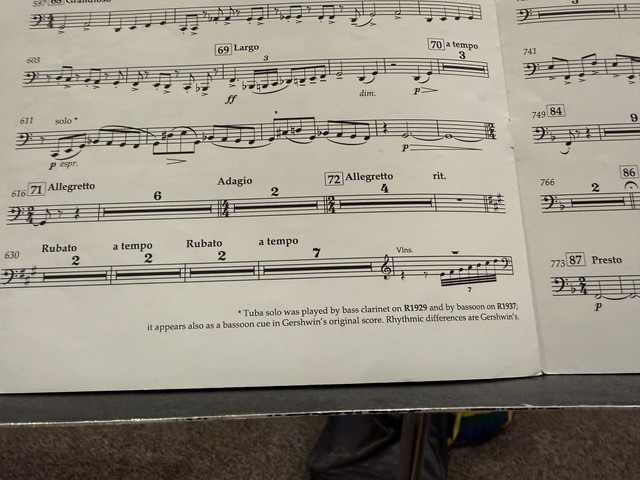
Here is the tuba part of this edition you mention with the editorial notes.
- These users thanked the author russiantuba for the post:
- 1 Ton Tommy (Sun May 03, 2026 10:27 am)
Dr. James M. Green
Lecturer in Music--Ohio Northern University
Adjunct Professor of Music--Ohio Christian University
Gronitz PF 125
Miraphone 1291CC
Miraphone Performing Artist
www.russiantuba.com
Lecturer in Music--Ohio Northern University
Adjunct Professor of Music--Ohio Christian University
Gronitz PF 125
Miraphone 1291CC
Miraphone Performing Artist
www.russiantuba.com
-
russiantuba
- Posts: 968
- Joined: Thu Aug 13, 2020 8:04 am
- Location: Circleville, Ohio
- Has thanked: 79 times
- Been thanked: 388 times
- Contact:
Re: The American in Paris Solo--Some Thoughts
tubanh84 wrote: Fri May 01, 2026 11:55 amMy opinion boils down to: Then every recording and performance would be identical. If you could even figure out the intention. No one thinks every Shakespeare performance needs to be the same. The only performance that has ever been perfected such that it can’t be done differently is Robert Preston’s Harold Hill in the Music Man. I will die on this hill.arpthark wrote: Fri May 01, 2026 11:34 am100% agreed. I had some really interesting courses in grad school that tackled this topic.Colby Fahrenbacher wrote: Fri May 01, 2026 11:05 am However, I squirm a bit anytime someone takes a hard stance on "composer intentions" though.
The problem we have, or the advantage, is that we have recordings of groups that Gershwin was working with during the recording or performance.
Rhapsory in Blue—he put a clarinet gliss. I have heard a couple recordings on reels recently where the performer scoops, growls, etc.
In this piece, where so many instruments have a solo, do you have this in the other instruments? Nope. The longer I seem to do this, the more instinctive these things just come, matching what others do, length and separation, phrasing, other style matching.
Since we have recordings, why wouldn’t Gershwin have asked for this even if not notated. The last few days, I’ve been working a Bach Cello Suite for fun and musical development. Rostropovich are my favorite recordings. He does nothing rubato with them, but are some of the most musical in line and direction.
Dr. James M. Green
Lecturer in Music--Ohio Northern University
Adjunct Professor of Music--Ohio Christian University
Gronitz PF 125
Miraphone 1291CC
Miraphone Performing Artist
www.russiantuba.com
Lecturer in Music--Ohio Northern University
Adjunct Professor of Music--Ohio Christian University
Gronitz PF 125
Miraphone 1291CC
Miraphone Performing Artist
www.russiantuba.com
-
UncleBeer
- Posts: 742
- Joined: Thu Aug 13, 2020 8:37 am
- Has thanked: 122 times
- Been thanked: 514 times
Re: The American in Paris Solo--Some Thoughts
Just for illustration, here's Gene's 2nd example off his excerpt CD. If a player seriously played it this way in public, I'd hope his colleagues (not to mention the conductor) would take him aside for a friendly intervention.
- These users thanked the author UncleBeer for the post:
- 1 Ton Tommy (Sun May 03, 2026 10:32 am)
Re: The American in Paris Solo--Some Thoughts
But I guess my point is - Is the composer right? And if the composer is always right, what is the point of conductors? Or different performers? Putting a work in the hands of another artist to interpret as they see it is the point of art. That's why we have so many different performances of Hamlet to discuss and enjoy.russiantuba wrote: Fri May 01, 2026 1:25 pm
The problem we have, or the advantage, is that we have recordings of groups that Gershwin was working with during the recording or performance.
I go back to Bernstein's speech before he performed the Brahms concerto with Glenn Gould. He thought it was wrong but important and needed to be taken seriously.
My point is that an interpretive choice doesn't have to start with "is this what the composer wanted," if it is a serious expression of how you hear the music. I understand that this can be taken to an absurd extreme, but so can everything.
-
bort2.0
- Posts: 6025
- Joined: Thu Aug 13, 2020 9:13 am
- Location: Minneapolis
- Has thanked: 471 times
- Been thanked: 1286 times
