Tubas, euphoniums, mouthpieces, and anything music-related.
Forum rules
This section is for posts that are directly related to performance, performers, or equipment. Social issues are allowed, as long as they are directly related to those categories. If you see a post that you cannot respond to with respect and courtesy, we ask that you do not respond at all.
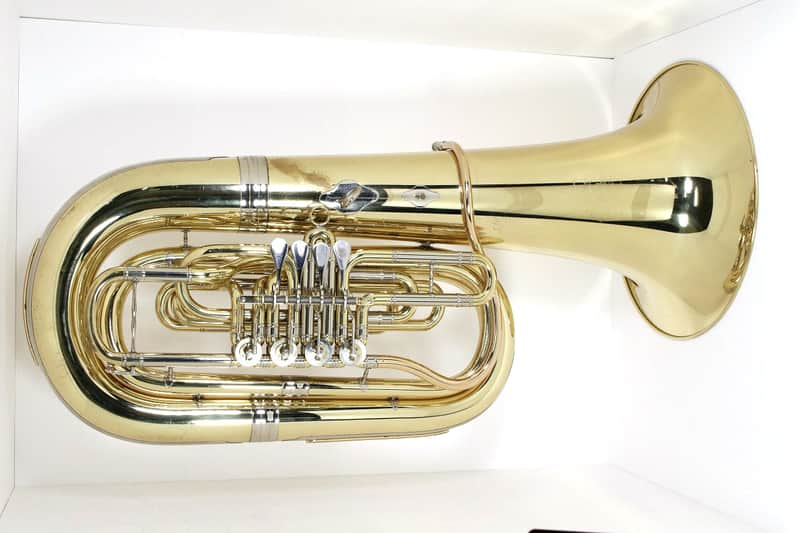
It has some odd characteristics for a B and S, 45 degree exit from the valveset, straight approach at the top, and a very long leadpipe. I can't tell the bell size, but no kranz. Made in Germany stamp, so post reunification, but no Perantucci branding. It's listed as a C tuba but it looks Bb to me.
Weltklang B&S Symphonie F tuba
Sanders (Cerveney 686) C tuba
This is really interesting. Looks like a PT6 predecessor that takes a lot of inspiration from Alexander. Would LOVE to play it for a bit. But not enough to try to justify buying it.
Definitely a BBb. You can find some pics elsewhere on the web if you search. The archived B&S website on the Internet Archive shows a model 3105 as early as 2011, but that has a vertical main tuning slide. I'm guessing this is a less common '00s model.
These users thanked the author arpthark for the post:
A few early reunification B&S instruments seem to have been built from mixes and matches of Geretsried-made parts and Markneukirchen-made parts.
I tend to suspect that the 1990s VMI 4/4 C and BB-flat rotary tubas were combinations of model 20 and model 3X West German bodies and bells mated with East German valve sets.
Last edited by bloke on Thu Feb 26, 2026 6:23 pm, edited 1 time in total.
These users thanked the author bloke for the post:
I don't make too much of that sidewise exit from the valveset as a "feature"...essentially this tuba layout has been around almost 100 years. The first tuba I bought new was like it I got it from Norm Bartold in the early 80's. Badged as a "La Sete", it'd been on a dusty shelf for 15-20 years at the time, probably made when Bartold & his brothers had a chain of music stores in So California in the 50's & 60's. ("3106" is a number consistent with Dan P and Bob T's earliest offerings of a "line" of tubas, so...the ebay horn is late 80's til maybe '92 or '93. Probably spent some time on a shelf too!) My La Sete was a great first horn, I changed out the clocksprings & levers for a Mirafone paddle setup and sold it when Tony got me my 184 in 1983. No idea why I got on an equipment kick so damn early in my "serious" years that La Sete was from an era when buying a tuba was an investment for your lifetime....last I heard that 60+ year-old tuba's still in regular use somewhere in the California Central Valley.
These users thanked the author dp for the post (total 3):
bloke (Thu Feb 26, 2026 10:34 am) • Rick Denney (Thu Feb 26, 2026 12:08 pm) • prodigal (Thu Feb 26, 2026 5:38 pm)
B&S 3098 PT-6
B&S "Sonora" CC
B&S 4196 PT-4P
Holton 345 CC und große tuben machen spaß. Ich brauche keinen anderen grund.
Obviously, a 45° angle coming out of the top of the first rotor and out of the bottom of the fourth rotor simplifies the bending of the mouth pipe and of a main slide connector branch, but it also involves complications and special circumstances in rotary valve casing production.
Obviously at some point it was determined that bending technology had improved to the point that there was no practical reason anymore to make those two special rotary valve casing configurations, as they have disappeared from production.
Further, an advantage of eliminating it in the first rotor - in particular - defines that only one rotor type will accommodate both a four valve and a five valve configuration.
That's a bunch of words to simply say that I agree with Dale, in that it's really not a "feature" - other than it's noticeable, because most human observations are made with the eyes.
prodigal wrote: Thu Feb 26, 2026 9:24 am
B&S tubas just look weird to me with a horizontal main tuning slide, it looks like the love child of a B&S and a 187 hookup.
It’s a Bb thing. The 101 always had the sideways main slide from the time before B&S was even B&S.
It was modeled on the Bb Alex 163 of old, also with a sideways slide, going back to the 30’s when Hess started making them.
I see the 3xxx model numbering as being a VMI innovation following unification, when the 101 morphed into the somewhat less good 3103 and its many clones.
It’s the same with the old Bb 104 kaiser and the Alexander 164 on which it was based that Jake also wrote about.
These are all derived from the original Cerveny rotary contrabass tubas of the 1870’s, which led to the Bohland and Fuchs, etc., and all had sideways slides.
The F tubas and C tubas had the vertical slide.
What I don’t get is what distinguishes the 3106 from the 3103—I wonder if it’s bigger.
arpthark wrote: Thu Feb 26, 2026 10:34 am
Here's a pic from a Japanese website. It looks kinda like a Yamaha 641 from this angle. Seems to be 4/4-ish sized.
Yeah, it definitely looks like a 641 in your pic.
1960 186CC
B&S 5099/PT-15
Cerveny 653
B&S PT-1
A bunch of string instruments
Rick Denney wrote: Thu Feb 26, 2026 12:53 pm
What I don’t get is what distinguishes the 3106 from the 3103—I wonder if it’s bigger.
probably bell diameter, and I've decided that in regards to pitch on these modern-er instruments,
the vertical/horizontal slide (like the angled entry/exit at the valveset) isn't a "feature" either
So here's a 3103, described as a BBflat, on Reverb, with a vertical tuning slide
And my B&S Sonora pitched in CC with a horizontal slide. Some people call it a CC Symphonie, I call it a lucky find.
Giardinelli CC.jpg (90.42 KiB) Viewed 16516 times
B&S 3098 PT-6
B&S "Sonora" CC
B&S 4196 PT-4P
Holton 345 CC und große tuben machen spaß. Ich brauche keinen anderen grund.
arpthark wrote: Thu Feb 26, 2026 7:52 am
Definitely a BBb. You can find some pics elsewhere on the web if you search. The archived B&S website on the Internet Archive shows a model 3105 as early as 2011, but that has a vertical main tuning slide. I'm guessing this is a less common '00s model.
arpthark appears to be on the right track. I recently purchased a used B&S Model BS3106 that (according to a factory representative, whom I thank very kindly) was built on July 9 1979. It is a 6-rotary BBb that generally has the attributes of the "1973-1982 Second Production Series" as described in BerlinerTuba's excellent article https://brassandpipes.wordpress.com/202 ... .Attaching a photo of the horn. When you point to the photo, there is a little "right arrow" ">" that takes you to an original spec sheet that the rep attached. [EDIT 05 JUL 26 -- I added some details to improve image clarity.]
The topmost two photos in this thread show a four-valve horn with the marking "3106" on the bell. According to the factory spec sheet I received, that horn would have had model number "3103" in 1979 (which may answer Rick Denney's question and dp's guess above), and the model number "3105" that arpthark refers to would have designated a 5-valve in 1979. Bottom line -- It appears that B&S recycled its model numbers, maybe more than once.
PS. Clear as mud?
PPS. I love this horn!!! Except for taking one of my helicons to Memorial Day service, I haven't hefted any other tuba for three months.
These users thanked the author PRO for the post (total 4):
The factory sent me a "Produktblatt" (spec sheet). It says bell 420 mm, weight 8.5 kg, bore 19.0 mm. (That's bell 16.5", weight 19 lbs, and bore 0.750".)
Measurements on my 1979 BS3106 -- height from bottom to top of body 30", height from bottom to top of bell 41", width 18". I made the measurements with a tape measure and estimate they are plus-minus one-half inch. This horn has no keel, just a bottom guard plate and a bottom guard wire.
Overall neither a big horn nor heavy -- juuuuuuuuust right.



 years
 that La Sete was from an era when buying a tuba was an investment for your lifetime....last I heard that 60+ year-old tuba's still in regular use somewhere in the California Central Valley.