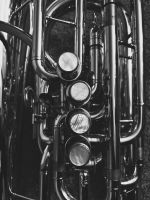
Both my 32-in 19-in bell B flat and the huge model 98 have some quirks when they are cold. I'm not a scientist, but I've sort of decided that I'm possibly right that the quirks are due to the farthest outer bows - particularly the big top bow and possibly the bell a little bit - remaining cold the longest.
With the huge tuba third partial F (as with many six quarter tubas) is slightly flat... At the tubas coldest perhaps 10 cents, but when this tuba is fully warmed up, that F is spot on... ie. no favoring, and I have to be a bit careful about not playing that third partial open F a bit sharp at that time, as - for the first five or minutes or so - I shall have been favoring it.
(Sometime, maybe I should make a quick and honest video of an electronic tuner picking up the open pitches of the 98. It's pretty astonishing...in a good way.)
The 32-in tall B flat tuba (with Holton/York bows and bell, and with a highly adulterated King 2341 valve set mounted on it) features a flat fourth partial B flat (until it's warmed up) and then that same B flat creeps up disproportionately (thank goodness) in comparison to the other open pitches, until it's only very slightly flat by nature and then very easy (so as one isn't even aware they're doing it) to favor up just a very small amount higher.
=======================
Predictably, as the bugle of the model 98 gets distorted in taper by adding cylindrical tubing, tuning anomalies begin to occur when cylindrical tubing valve circuits are added.
Mostly, the first valve slide pulls are predictable and proportional based on how much tubing is added, yet fifth partial open D is spot on, and the lower one descends into the fifth partial, the pitch gets lower - whereas second valve d flat needs a little bit of favoring (unless one was to push in the second slide which I'm just not going to do under any circumstances), first valve c requires pushing the first slide all the way in (and I've actually adjusted the circuit length for the first valve to accommodate this completely), but then adding one more valve to play 1-2 B natural defines that the first slide comes out perhaps 3/16 of an inch or less for a perfect B natural. (I've experienced similar effects with other Kaiser taper B flat tubas, yet - with most of the other ones - the whole string of 5th partial pitches begins with a badly flat open D and then gets hopelessly and irreparably worse, unlike what I described above with the model 98...so what I'm saying is that I don't use any alternate fingerings, and every valve combination I use on this instrument is found in the fronts of beginner band method books).
With the 2-3 combination, I have the third circuit set whereas the low F sharp and the F sharp up in the staff are tuned just about perfectly in the default position. The C sharp below the staff is very subtly flat, and - as with many brass instruments - the F-sharp at the bottom of the staff itself is flatter than the C sharp. Those of you have been on the repair forum have seen how I have addressed that issue by making that slide accessible with a left hand wrist push (while being able to keep my left hand fingertips on the #1 slide) and with an auto return spring for the #3 slide. If I'm playing some busy passages in the middle range of the tuba - and in a "sharps key signature", I'll probably just keep that #3 slide pushed in with my wrist.


With the 98, my workaround for B natural below the staff and C natural conflicting with each other (regarding the #4 circuit length) I simply play C natural with 1-3 and a pretty vigorous #1 slide pull (that slide having an aftermarket stop rod), and the #4 circuit pretty much tuned for 2-4 B-natural, which - serendipitously - is right at the same length required to play the double low range first partial pitches (very low E flat down to extremely low B natural) close to In tune (other than of course 5-2-3-4 double low C, which & if actually needed - I would probably play with third valve alone anyway).
...so the huge model 98: (as Napoleon Dynamite would say) It's got skills.
A lot of this is probably really boring, but maybe it helps someone with their tuning strategies on their own B-flat or C (simply transposing all of my comments by a whole step) instruments...
but if the open partials aren't as in tune as they are with this serendipitous Model 98, then I would predict more issues that would need to be addressed...
... As an example, I've yet to have played a model 836 C tuba whereby the #1 slide would retract enough to play first valve D up to pitch without serious favoring, whereby I might consider shortening that circuit, but shortening it in such a way that didn't shorten the slide tubes themselves.